OpenAI Enters the Online Ad Business: What a New Player at Cannes Lions 2026 Means for Advertisers
The online advertising business just got a new, very well-funded competitor. At Cannes Lions 2026, OpenAI confirmed it is no longer just an AI research company experimenting with monetisation — it is actively building a full-scale ad business inside ChatGPT, and it wants brands, agencies, and ad-tech players to take notice now.**
For most of its history, OpenAI insisted it would never run ads. That position has quietly reversed over the past few months, and at this year’s Cannes Lions International Festival of Creativity, the company made its intentions impossible to ignore. In its first-ever appearance at the festival, OpenAI didn’t show up to talk about AI safety or research breakthroughs. It showed up to pitch itself as the newest serious player in digital advertising, and to lay out exactly how it plans to compete with Google and Meta for ad budgets. For anyone working in media, marketing, or out-of-home advertising, this is the kind of shift worth understanding early, not after the next big platform realignment has already happened.
Why This New Entrant Is Different From Other Ad Platforms
Every few years, a new platform tries to convince advertisers it deserves a slice of their budget. What makes OpenAI’s entry worth paying attention to is the nature of the inventory itself. Dave Dugan, OpenAI’s vice-president and head of global ads solutions, made the company’s pitch at Cannes by drawing a sharp line between ChatGPT and the platforms advertisers already know well. People don’t open ChatGPT to scroll, he said; they open it to solve a problem or research a decision. That distinction matters for advertisers because it suggests a different kind of attention, one built around intent rather than idle browsing.
Dugan backed that claim with numbers: a meaningful share of ChatGPT queries already carry direct commercial intent, and an even larger share show earlier-stage signals that a purchase decision may be coming. For brands used to bidding for attention in increasingly noisy and AI-flooded social feeds, a platform built around people actively trying to make decisions is a genuinely different value proposition, and it’s part of why OpenAI’s entry into advertising deserves more than a passing glance.
From Pilot to Global Rollout, Fast
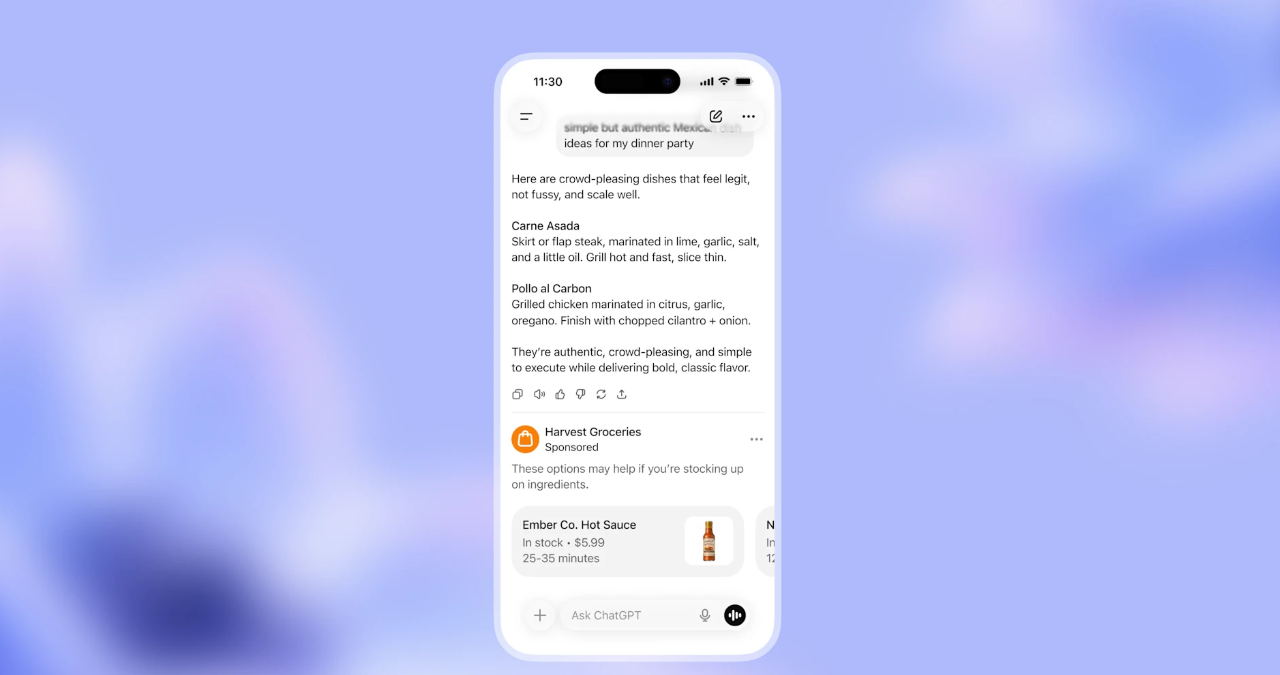
New entrants in advertising usually take years to scale. OpenAI is compressing that timeline. Its ad pilot launched in February for users on free and lower-tier ChatGPT plans, appearing as clearly labelled sponsored content beneath the platform’s main answers. Within four months, it had expanded from the United States into Canada, the United Kingdom, Australia, New Zealand, Japan, and South Korea, with confirmed plans to add Brazil and Mexico next, and India to follow.
That speed is backed by real partner numbers, not just ambition. Criteo, OpenAI’s first advertising technology partner, told Cannes attendees that thousands of brands are already running ads inside ChatGPT through its integration, with apparel, home furnishings, consumer electronics, automotive, and beauty leading the categories. Criteo also shared performance data worth flagging for any media buyer evaluating where to test budget next: campaigns using its Prompt Smart Ads format are seeing roughly four times higher spend after activation, click-through rates two to three times higher than comparable formats elsewhere, and more than 80 percent of resulting traffic coming from entirely new customers. That last figure is the one advertisers should sit with. It suggests ChatGPT isn’t just another retargeting channel competing for the same warm audience everyone else is chasing — it’s functioning as a genuine discovery engine.
OpenAI’s own ambitions go further still. The company has reportedly set a target of $100 billion in annual ad revenue by 2030, roughly half of what Meta currently earns from advertising today. Some analysts estimate 2026 revenue could land near $2.4 billion, though OpenAI hasn’t confirmed the number. Either way, for a business that didn’t exist a year ago, that is an extraordinary growth curve, and it explains why OpenAI’s leadership has openly said ad revenue will be used to subsidise and expand access to its core product.
The Real Disruption: AI That Builds the Campaign, Not Just Places It
Here’s where the value for readers goes beyond just “another platform sells ads now.” OpenAI’s bigger bet is on changing how campaigns get made in the first place, and that’s arguably more disruptive to the existing ad ecosystem than the ad inventory itself.
OpenAI creative specialist Chad Nelson demonstrated this live at Cannes using Codex, the company’s AI coding agent. Working alone, with no formal coding background, Nelson said he built a complete campaign tool for a fictional car brand in about two and a half days, then used it to generate a full visual campaign for a local car dealership, a tool he said could be deployed across an entire organisation once built. His point wasn’t that AI can make one ad faster. It was that brands today need tens of thousands of creative assets across languages, audiences, formats, and platforms, and that scale of demand is exactly the gap OpenAI’s tools are built to close.
Nelson’s framing for what this means for creative careers is worth noting for anyone in the production pipeline: he described the shift as turning creative directors into something closer to R&D directors, spending less time producing individual assets and more time designing the systems that generate them at scale. Whether or not that reassurance lands with creatives watching their production budgets shrink, it signals where OpenAI thinks the real value of its platform sits, not just in selling impressions, but in collapsing the cost and time of production itself.
What Advertisers and Agencies Should Take From This
A new, well-capitalised player entering online advertising rarely changes the market overnight, but it does change the questions worth asking now. A few takeaways for marketers, media planners, and anyone in the out-of-home and digital advertising ecosystem watching this space:
Intent-based inventory is back on the table. ChatGPT’s ad model leans on commercial intent rather than scroll-stopping creative, which means measurement and targeting logic built for social feeds may not translate directly.
New-customer discovery is the headline metric. If Criteo’s early data holds up at scale, ChatGPT could become a genuine acquisition channel rather than just another place to retarget existing audiences. Production economics are shifting, not just media buying. Tools like Codex point toward a future where smaller teams produce far larger volumes of creative variants, which has implications for agency staffing, production costs, and how quickly campaigns can be localised across markets. Geographic rollout pace matters. With Brazil, Mexico, and eventually India on the roadmap, advertisers in those markets should expect ChatGPT inventory to become a live consideration sooner rather than later.
OpenAI’s debut at Cannes Lions wasn’t a research showcase dressed up for an advertising audience. It was a company that has clearly decided advertising is now core to its business model, arriving at the industry’s biggest stage to say so directly. For an industry that has watched platform shifts before, from the rise of programmatic to the growth of connected TV and digital out-of-home, the lesson is familiar: the players who study a new entrant’s economics early are usually the ones best positioned when that platform becomes too large to ignore.