Meta Launches Complete AI Creative Ad Ecosystem at Cannes Lions 2026
Meta used Cannes Lions 2026 to announce what it calls a complete, end-to-end AI-powered advertising ecosystem, spanning automated creative generation, a unified hub for creator partnerships, and AI-enabled commerce experiences. The company says the goal is to let “every marketer cross the AI threshold,” and the rollout touches nearly every stage of the campaign lifecycle, from the first creative brief to the final checkout. For years, AI in advertising has meant incremental upgrades: a smarter bidding algorithm here, an auto-generated headline variant there. What Meta unveiled at this year’s Cannes Lions International Festival of Creativity is something more structural. Rather than adding another isolated AI feature to Ads Manager, the company is positioning AI as connective tissue running through creative production, creator partnerships, and customer engagement, all feeding into a single, compounding system. For marketers, agencies, and anyone in the broader advertising and out-of-home ecosystem trying to separate genuine platform shifts from conference hype, this announcement is worth a close read.
The Numbers Behind the Pitch
Meta didn’t just lead with feature names. It led with performance data, the kind that tends to carry more weight with marketers than a product demo alone. According to the company, an analysis of more than one million ad campaigns found that every dollar spent on Meta’s platforms generated $4.13 in revenue on average for advertisers, a 25 percent increase since 2022. That figure is doing a lot of work in Meta’s narrative: it’s the evidence the company points to when arguing that AI in ad ranking and delivery has already proven itself, and that automation is now ready to do the same for ad creative, not just ad placement.
Meta also cited a broader behavioural shift underpinning the whole announcement: roughly 3.5 billion people across its apps now encounter AI-driven product recommendations daily. That scale is the backdrop against which Meta is positioning AI not as an experimental add-on, but as infrastructure its advertising business already depends on.
An End-to-End Creative Workspace
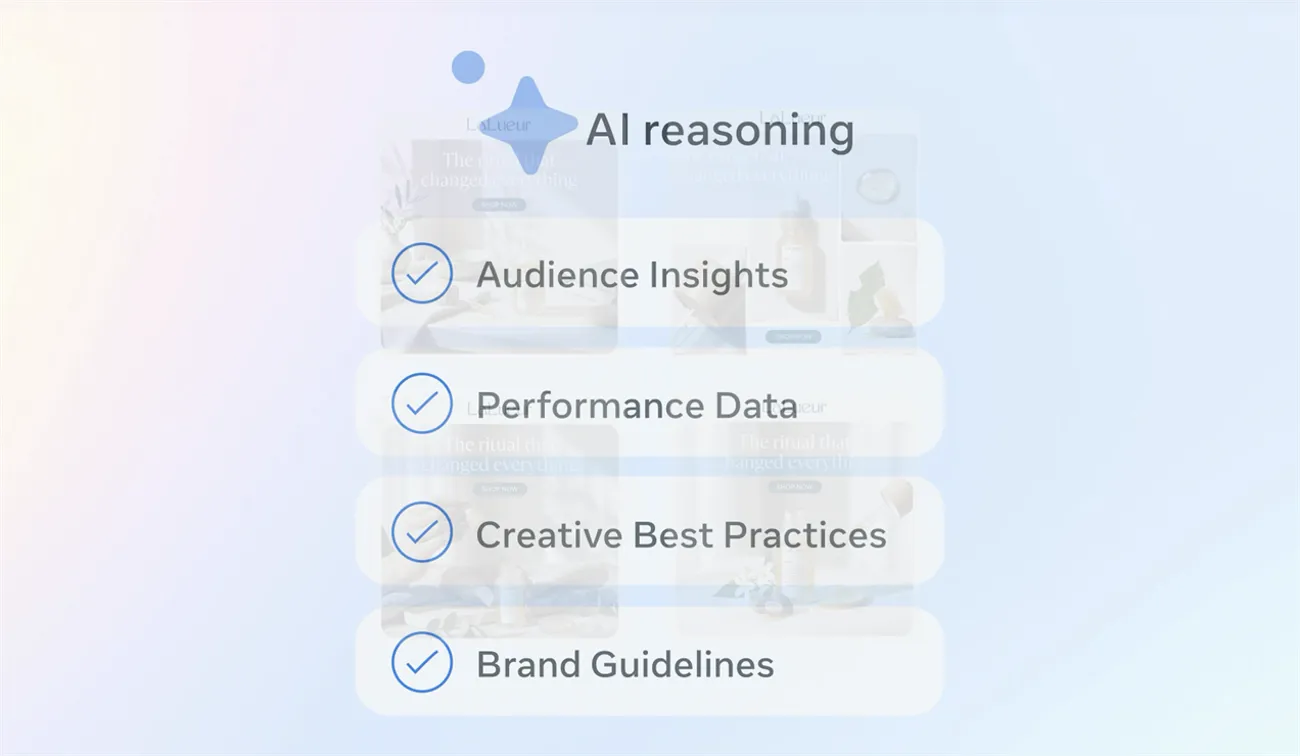
At the centre of the announcement is what Meta describes as its first true end-to-end creative solution inside Ads Manager. Instead of treating performance reporting and creative production as separate workflows, the new system gives marketers a single, brand-aware workspace where they can review what’s working in a campaign, generate new creative variants based on those results, and test concepts without leaving the platform.
A few specific capabilities stand out for marketers evaluating whether this is more than a rebrand of existing tools:
Brand memory. A new capability that learns a brand’s visual identity and tone from its past campaigns, then applies that learned style to AI-generated creative so output stays on-brand without manual oversight on every asset. Advertisers can refine these settings directly.
A built-in creative approval workflow, currently in testing, that lets teams review and sign off on AI-generated modifications inside Ads Manager rather than routing assets through external approval tools.
Expanded text generation, including AI-written copy that appears directly within image ads, drawing on a brand’s past campaign performance and business information to produce multiple messaging variations.
Wider language support for AI-generated text-on-image content**, now extending to Portuguese, French, German, Italian, and Indonesian, a meaningful detail for any brand running multi-market campaigns.
Meta is also working directly with agency partners to fold these tools into existing workflows rather than asking teams to adopt a separate system. Its collaboration with WPP, integrating the new creative experience into WPP Open, is the clearest signal yet that Meta wants this to sit inside agencies’ established production pipelines, not compete with them from the outside.
Creator Marketing Gets Consolidated
The second pillar of the announcement addresses a problem many brands already know well: creator marketing and paid partnership tools have historically lived in separate Meta products. That changes with the new Meta Creator Marketing Hub, which will merge Creator Marketplace and Partnership Ads Hub into a single destination later this year.
The consolidation is more than a cosmetic merge. Creator Marketplace, which already lists more than five million Instagram creators, is being expanded to include Facebook creators for the first time, giving brands a single interface to discover and connect with talent across both platforms. The hub will also surface creator content brands haven’t previously worked with, including user-generated and product-tagged posts, with performance insights built directly into the discovery process. In practical terms, that means a brand searching for partnership opportunities won’t be limited to creators it already has a relationship with; it will be able to find and activate relevant organic content from anyone already talking about its products.
This sits alongside a separate, earlier wave of commerce-focused updates Meta rolled out ahead of Cannes: global Live Video Ads on Facebook and a new launch on Instagram, expanded affiliate product tagging now live for creators in 22 countries, and new regional affiliate partnerships, including Flipkart in India, Lazada across Asia-Pacific, and an extended Mercado Libre partnership covering Brazil and Mexico. Together with the Creator Marketing Hub, these moves point toward the same destination: a tighter, more automated link between creator content, commerce, and paid media.
AI-Enabled Customer Engagement
The third piece of Meta’s announcement extends AI beyond creative production and into post-click engagement. Building on its Business Agent Platform, Meta is rolling out AI-driven shopping experiences such as WhatsApp’s “complete the look” suggestions, which recommend additional, complementary purchases based on what a customer has already shown interest in. The company frames this as closing the loop between discovery, creative, and conversion, so that an AI-generated ad isn’t just optimised to get a click, but is followed by an AI-assisted experience designed to turn that click into a transaction.
Why This Matters: A Note on Trustworthy Evaluation
Big platform announcements at Cannes are easy to take at face value, and just as easy to dismiss as marketing theatre. The responsible way to read this one sits somewhere in between. Meta’s $4.13-per-dollar figure is self-reported and drawn from its own campaign data, which means it reflects results within Meta’s own ecosystem rather than an independent, third-party benchmark; advertisers should treat it as a directional claim worth testing against their own campaign data, not a guaranteed outcome. At the same time, the structural changes, brand memory, a unified creator hub, and built-in approval workflows, address real, well-documented pain points that marketers and agencies have raised for years: inconsistent AI-generated creative, fragmented creator tools, and slow internal approval cycles. Those are concrete product decisions, not just slogans, and they’re a reasonable basis for cautious optimism.
For brands and agencies deciding how quickly to adopt these tools, a sensible approach is the same one that has applied to every major ad-platform shift before it: run a controlled test against current creative and creator workflows, measure the brand-memory output against your own style guidelines before scaling it, and treat the approval-workflow feature, since it’s explicitly still in testing, as something to pilot rather than fully replace existing review processes with on day one.
What It Signals for the Wider Advertising Industry
Meta’s announcement lands in a competitive moment. OpenAI used its own Cannes Lions debut this year to pitch ChatGPT as a new advertising surface built on commercial intent, while platforms including TikTok and Snap have been rolling out their own AI creative-generation tools. Meta’s response is to argue that no other platform can match the scale of its first-party data, its creator network, and its commerce infrastructure operating as one connected system, rather than as separate point solutions.
For marketers and media planners working across digital and out-of-home channels, the practical takeaway is less about any single feature and more about direction. AI-assisted creative production, automated creator discovery, and commerce-linked ad formats are converging into unified platform ecosystems rather than scattered tools, and that consolidation is likely to accelerate, not slow down, over the next year. Brands that start testing these workflows now, with a clear-eyed view of what’s proven versus what’s still in beta, will be better positioned than those waiting for the dust to settle.