OOH Idea of the Day: Ugaoo’s Billboard That Stops Advertising — And Starts Growing
The One-Line Pitch
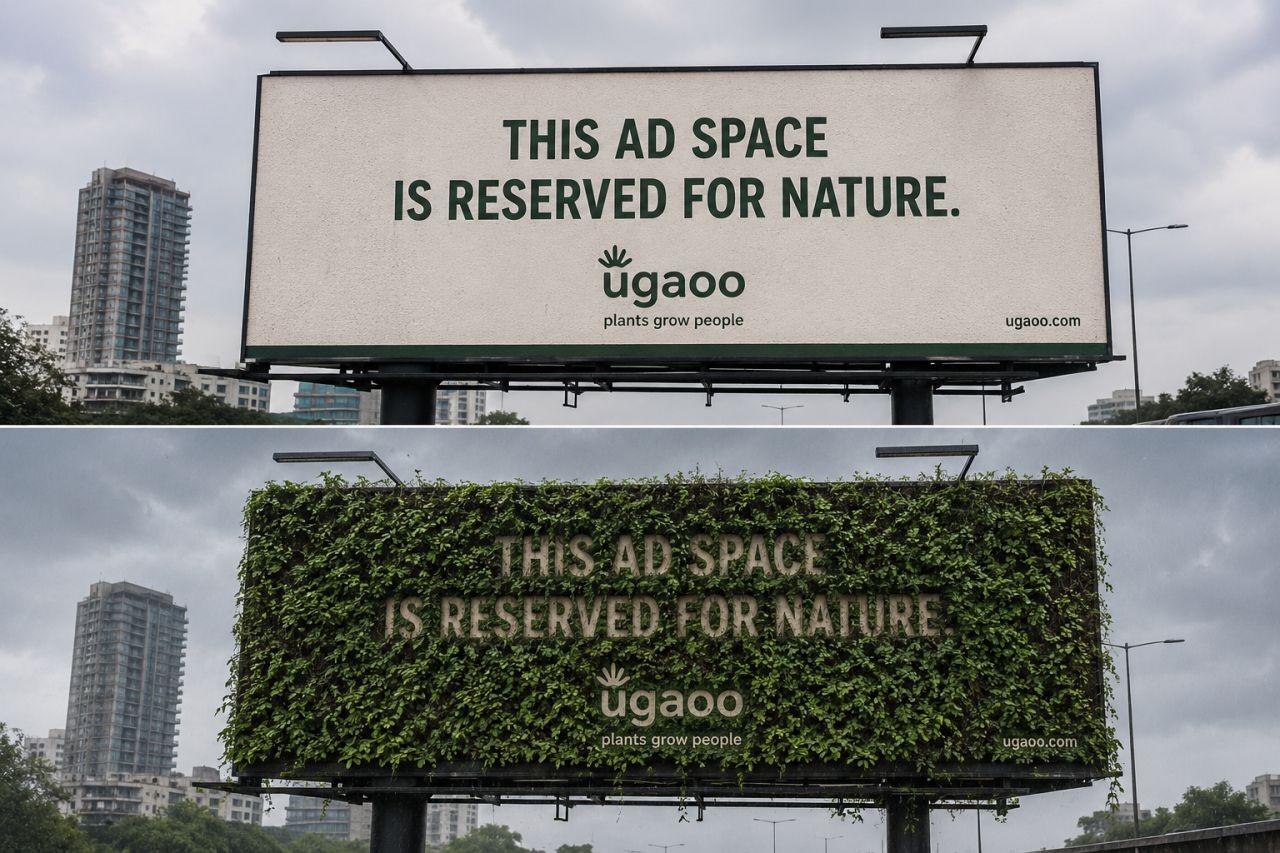
A billboard that says “This ad space is reserved for nature” — and then, rain by rain, proves it by disappearing under real, growing plants.
That’s the entire creative tension in this concept from Ugaoo, India’s plant and gardening brand. No tagline gymnastics, no celebrity endorsement, no QR code funnel. Just a structure, a season, and a brand willing to let the weather finish its ad for it.
What’s Actually Happening Here
Most OOH executions are built to be seen once and remembered. This one is built to be watched over time. Here’s the mechanic, stripped down:
- The billboard is fabricated using a seed-embedded surface — a substrate that holds dormant seeds within its printed panel.
- The headline copy (“This ad space is reserved for nature”) is printed on this same surface.
- When monsoon rain hits, it doesn’t damage the board — it activates it. Moisture triggers germination.
- Over the following weeks, sprouts physically push through and over the lettering, slowly erasing the message by replacing it with the thing it was describing.
- By the end of the season, what started as a flat, printed advertisement has become a live, three-dimensional patch of greenery on a public street.
The billboard doesn’t get torn down and replaced with the next client’s ad. It gets overgrown by its own message.
Why This Works — A Marketer’s Read
It’s easy to call this “creative” and move on. But the reason it’s worth studying is more specific than that. Three things are doing real work here:
1. The medium matches the claim. A plant brand telling people to “let nature grow” through a static, printed board would be a contradiction — words about nature, delivered through paper and ink, same as everyone else. By using rain as the literal mechanism of the ad’s transformation, Ugaoo removes the gap between message and medium. The board doesn’t talk about growth. It grows.
2. It converts a logistical weakness into the core idea. Monsoon season is traditionally the worst time to run OOH in India — boards get damaged, visibility drops, media owners often discount inventory. This concept takes that exact liability (rain ruins billboards) and inverts it into the campaign’s only fuel source. Nothing here works without the monsoon. That’s a tight idea, not a decorative one.
3. It’s designed for repeat viewing, not a single glance. A normal billboard is consumed in the 2–3 seconds someone has at a traffic signal. This one is designed to be checked on — commuters passing the same spot week after week have a reason to look again, because it looks different each time. That’s earned attention compounding over a season, not bought attention spent in one flight.
The Strategic Layer: What It Says About the Brand
Ugaoo’s stated identity is built around making plants a normal, everyday part of urban life — not a hobby for the few, but a habit for the many. A campaign that simply instructs people to garden sits a little awkwardly next to that identity; it’s the brand talking at people.
This concept does something different: it removes the brand’s voice from the equation almost entirely. The copy disappears. There’s no logo doing the heavy lifting at the end. The “proof” is the plant itself, growing in a public space, doing what plants do when given room. The brand’s role shifts from narrator to enabler — which is arguably the more credible position for a plant company to hold.
Where This Kind of OOH Fits in the Bigger Picture
If you work in brand or media planning, this concept is a useful case study in a broader trend worth tracking: seasonally-activated and bio-responsive OOH — formats where weather, light, pollution, or time of day physically change the creative, rather than a digital screen simulating change. A few reasons this category is gaining ground:
- Sustainability is now a creative constraint, not a footnote. Seed paper, biodegradable substrates, and living materials are increasingly used not as a CSR add-on, but as the actual canvas of the ad.
- Attention is earned through change, not size. A board that looks the same for 30 days loses to the city’s visual noise. A board that visibly evolves earns a second and third look for free.
- Local context beats global templates. A campaign built around monsoon only works in geographies that have a monsoon. That specificity is a strength — it can’t be lifted and dropped into a market where it doesn’t make sense, which usually means it was built with real local insight in the first place.
The Takeaway for Brand & Marketing Teams
If you’re evaluating whether a “sustainable” OOH idea is genuinely strong or just sustainability-washed, ask these three questions — they’re the ones this concept passes:
| Question | Why it matters |
|---|---|
| Does the medium prove the message, or just state it? | Stops “green” from being a layer of paint over a normal ad |
| What’s the natural force or local condition doing the actual work? | Separates a real mechanic from a one-time stunt render |
| Does the brand disappear at the right moment? | Tests whether the idea serves the brand’s purpose or just its logo |
A billboard that lets nature finish the sentence is a small, sharp reminder that the most convincing advertising for a “natural” product is often the least manufactured-looking thing on the street.
This piece covers a creative OOH concept for Ugaoo. As with any concept-stage idea, real-world execution (substrate durability, civic permissions, germination consistency) would determine how faithfully the final build matches the vision described here.