Taksh Media Strengthens Outdoor Advertising Network Across J&K
If you’re a media planner who’s ever tried to book outdoor advertising in Jammu & Kashmir, you already know the headache: fragmented ownership, scattered municipal approvals, and a patchwork of vendors covering different towns. That problem just got a lot smaller. Taksh Media Pvt. Ltd. has quietly become the single biggest gatekeeper to outdoor ad space across the Union Territory, after picking up a string of exclusive, long-term rights that together cover Jammu Province, Srinagar, and one of India’s busiest pilgrimage circuits. For brands and agencies eyeing the region, this consolidation changes how an OOH campaign in J&K should actually be planned — fewer vendors to negotiate with, but also fewer alternatives if your dates or locations don’t line up with their inventory.
Here’s the breakdown, and what it means on the ground.
One Contract, 33 Towns
The biggest piece of this deal is a five-year, unified agreement giving Taksh Media sole rights to static outdoor advertising — unipoles, hoardings, static panels, and other approved formats — across 33 Urban Local Bodies in Jammu Division. That’s not just Jammu City. It stretches across the entire division’s commercial spine: Kathua, Samba, Udhampur, Rajouri, Poonch, Katra, Ramban, Banihal, and Doda, among others.
For a media planner, that single detail is the headline. Instead of stitching together nine or ten separate municipal vendor relationships to run a regional campaign from Lakhanpur (the gateway into J&K for road traffic from Punjab) down to Banihal, there’s now one point of contact for static OOH across the entire belt. According to the company, the Jammu City network alone includes 80 backlit unipoles, which gives advertisers a strong base of high-visibility, illuminated inventory for campaigns that need to perform in low-light hours too.
The Kashmir Valley: 191 Unipoles in Srinagar
Separately, Taksh Media secured exclusive rights to static unipole advertising panels across Srinagar Municipal Corporation, also for a five-year term. The company’s Managing Director, Ashok Kumar, described it as control over 191 premium unipoles across Srinagar city — a number that effectively makes the company the default route into static OOH in the Valley’s biggest commercial and tourist hub.
If your brand’s media plan includes Srinagar — whether for a tourism push, a retail launch, or seasonal visibility around the city’s peak travel months — this is now the network you’re working with for that specific format.
Katra: Digital Panels at One of India’s Busiest Pilgrim Routes
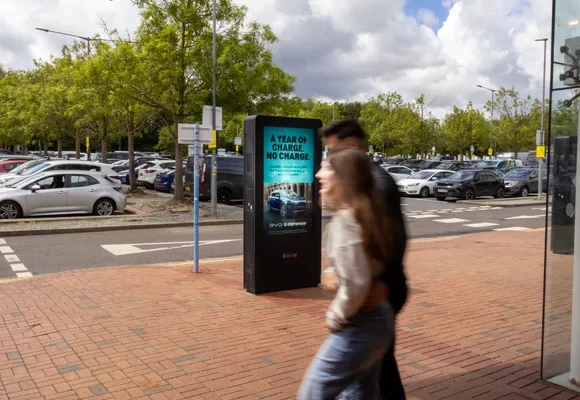
The most interesting addition for digital-first advertisers is in Katra, the base town for the Vaishno Devi shrine and one of the highest-footfall pilgrimage destinations in the country. Taksh Media has been named concessionaire — under a Design-Build-Finance-Operate-Transfer (DBFOT) model — for three Digital LED advertisement panels there, with a seven-year concession term.
The locations matter as much as the format: Darshani Deodi, Banganga Road, and Fountain Chowk are all high-dwell-time points along the pilgrim route, where footfall is dense and largely captive — people are walking, queuing, or pausing, not driving past at speed. For brands in categories like FMCG, devotional products, travel, or financial services that index well with pilgrim and tourist audiences, this is a genuinely scarce digital OOH asset in a market where large-format digital screens are still rare outside major metros.
What This Means If You’re Actually Planning the Buy
A few practical things follow from this consolidation, especially for anyone scoping an OOH plan in the region over the next campaign cycle:
- Negotiate at the network level, not the city level. With one operator controlling static inventory across Jammu Division, Srinagar, and Katra’s digital panels, there’s an opportunity to negotiate bundled, multi-town packages instead of booking city by city.
- Plan around format, not just geography. Static unipoles dominate Jammu and Srinagar; digital is currently concentrated in Katra. If your campaign needs dynamic creative or dayparting, Katra’s three LED panels are the only inventory that supports it right now under this deal.
- Book early for high-traffic windows. Pilgrimage and tourism-linked OOH in J&K is highly seasonal — Vaishno Devi yatra peaks, Amarnath season, and the Srinagar tourist calendar all create demand spikes. With inventory now centralized under one operator, popular slots are likely to fill faster than when supply was fragmented across multiple smaller vendors.
- Factor in the long-term nature of these rights. Five-to-seven-year exclusive concessions mean this is the OOH landscape in J&K for the foreseeable future, not a temporary vendor situation. Building a longer-term regional media relationship may be more efficient than treating it as a one-off booking.
The Bigger Picture
Ashok Kumar framed the company’s ambition as building a “single-window outdoor advertising solution” for the entire Union Territory — one vendor, multiple formats, end-to-end coverage from Lakhanpur to the Kashmir Valley. Whether or not that consolidation is good news for pricing competition is a fair question for the industry to keep watching. But for media planners trying to get a campaign live in Jammu & Kashmir, it does simplify a market that, until now, required juggling several relationships just to cover a handful of towns.
For brands looking to enter or expand in J&K — tourism, retail, telecom, FMCG, or devotional categories especially — this is worth a fresh look at the region’s OOH map before the next planning cycle.