Reliance Broadcast Goes All-In on Convergence With Launch of ONE BIG WORLD

Mumbai-based BIG FM parent stitches radio, digital, news, outdoor screens and live events into a single AI-driven platform, betting that advertisers want one partner instead of five.
Reliance Broadcast Network Limited (RBNL) has stopped thinking of itself as a radio company. With the launch of ONE BIG WORLD, the group behind BIG FM is repositioning itself as a full-stack media and entertainment ecosystem — one that pulls radio, digital content, news, digital out-of-home (DOOH) advertising and live experiences under a single, AI-powered roof.
It’s a significant pivot for a company that built its identity almost entirely on FM radio for nearly two decades. RBNL is betting that the future of media lies in convergence rather than staying confined to a single channel. The company’s own framing is blunt about the shift: this is a move from operating standalone media verticals to a converged ecosystem designed to engage consumers across physical and digital touchpoints.
What’s actually inside ONE BIG WORLD
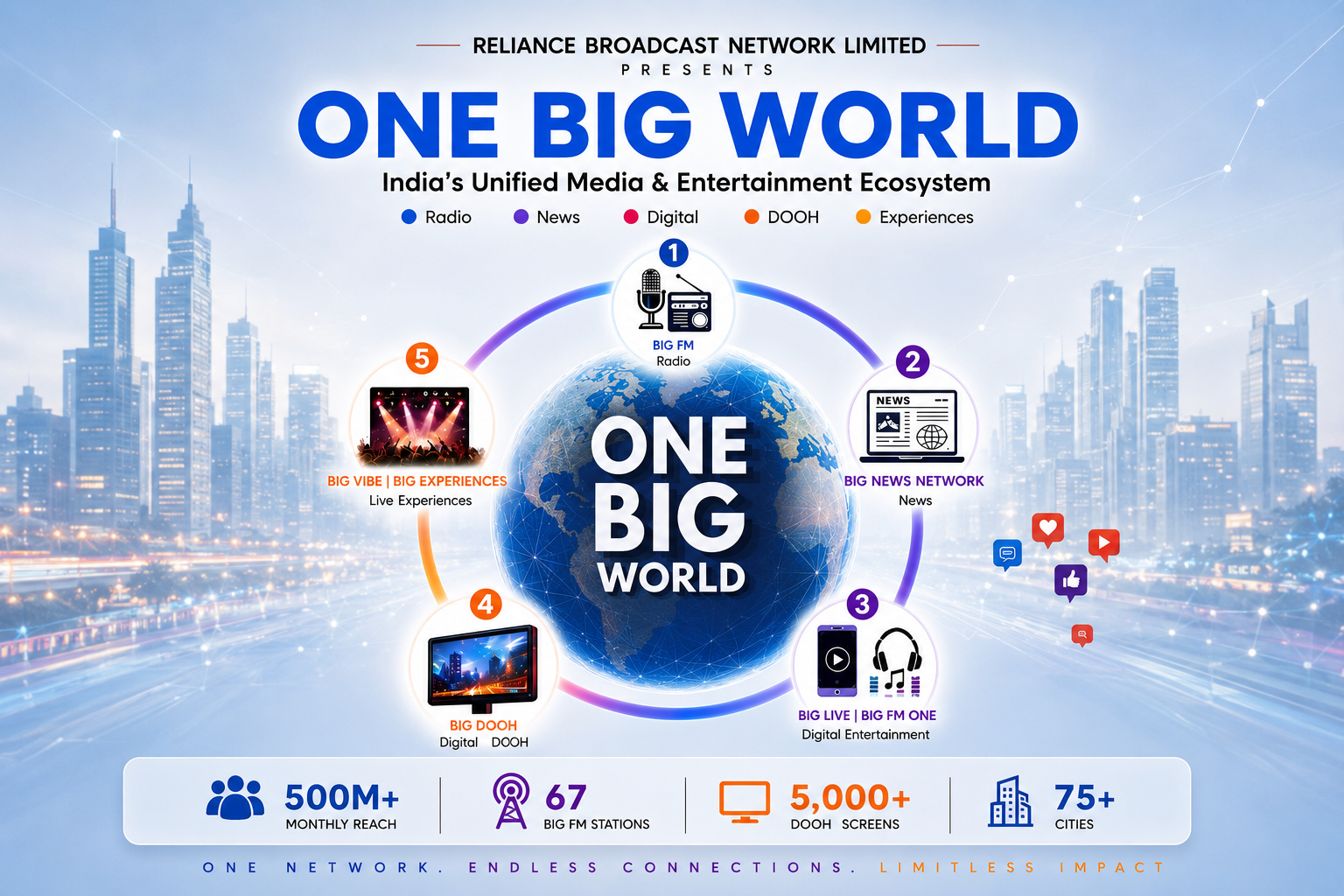
The new ecosystem isn’t a rebrand — it’s a consolidation of several businesses RBNL has been building quietly alongside its radio operations. The company says the platform currently reaches more than 500 million monthly users through 67 BIG FM radio stations, the BIG News Network, over 100 million lifetime BIG LIVE users, a social media reach of 20 million-plus, and more than 5,000 transit-based BIG DOOH screens across 75-plus cities. ations reaching 340 million-plus listeners across more than 1,900 towns and 1.2 lakh villages, and it’s now pushing into digital-first video content through what the company calls Video Radio Jockeys, or VRJs.
On the news side, BIG News Network is positioned as a social and digital-first broadcast news platform, with plans for additional regional channels and a dedicated business news channel in the pipeline. The outdoor advertising arm isn’t sitting still either — BIG DOOH’s transit-led network of over 5,000 premium screens is expected to evolve into a technology-enabled, programmatic advertising platform, which would let advertisers buy outdoor inventory the same way they buy digital display today.
New sub-brands have also been rolled out as part of the launch, including BIG FM ONE, an AI-powered digital destination offering hyperlocal and vernacular audio-video content, community engagement and commerce features; BIG LIVE, the company’s digital engagement arm; and BIG Social Connect, which is expected to expand through more than 100 new social media handles across categories. On the experiential front, RBNL has introduced BIG Vibe as a youth-focused live entertainment vertical, BIG Concerts & IPs to expand its portfolio of concerts, awards and festivals, and BIG Experiences, a dedicated MICE and enterprise events business.
The whole operation will run out of a new 60,000 sq. ft. facility in Noida.
Why now
The logic behind the launch is straightforward: audiences don’t sit still on one platform anymore, and advertisers are tired of stitching campaigns together across five different vendors. RBNL Chairman Sahil Mangla framed it as an evolution of trust rather than a departure from it. “For nearly two decades, BIG FM has built deep-rooted trust, hyperlocal relevance, and an unmatched emotional connection with Indian audiences,” Mangla said, adding that ONE BIG WORLD is “our strategic response to the evolving, non-linear consumer journey,” transforming the company “from a radio broadcaster into an indispensable daily companion — seamlessly integrating radio, news, digital, DOOH, and live experiences into one cohesive, AI-powered ecosystem.”
RBNL CEO Ashit Kukian made the advertiser pitch even more explicit. “With ONE BIG WORLD, we are unlocking a new dimension of value for consumers and advertising partners,” Kukian said. “Brands no longer need to piece together fragmented campaigns.” He described the offering as a set of in-house, 360-degree solutions spanning content creation, multi-channel distribution and on-ground activations across radio, news, digital, DOOH and experiential platforms — the pitch being fewer vendors, more accountability, and one dashboard for reach that used to be scattered.
The bigger picture
RBNL’s move lands in a moment when convergence has become the buzzword across Indian media, not just for radio players but for broadcasters and telcos alike — Reliance’s own JioStar has separately been building out GenAI-powered content tools, suggesting a group-wide push toward AI-assisted, unified media operations rather than siloed businesses competing for the same ad rupee. For advertisers, the appeal is simple on paper: instead of separately negotiating radio spots, news placements, transit screens and event sponsorships, ONE BIG WORLD offers a single point of entry with combined reach claims north of half a billion monthly users. Whether that translates into meaningfully better campaign outcomes — or simply a bigger, better-packaged sales pitch — will depend on how well RBNL can actually integrate measurement and targeting across such structurally different mediums as FM radio, transit screens and social platforms. That’s the harder engineering problem behind the announcement, and it’s the one advertisers will be watching most closely over the next few quarters.