Cannes Is Changing Its Guest List. Can Independent Agencies Keep Up With the Invitation?

For years, independent agencies at Cannes Lions were the scrappy outsiders — talented, occasionally brilliant, but standing at the edges of a festival built around holding company budgets and case-film spectacle. That picture looks increasingly outdated. This year, independents made up roughly a third of all entries at the Cannes Lions International Festival of Creativity, and four independent agency chief creative officers sat among the 27 jury presidents overseeing the awards. The numbers tell a clear story: independents aren’t knocking on the door anymore. They’re inside the room, and in some cases, they’re the ones setting the agenda.
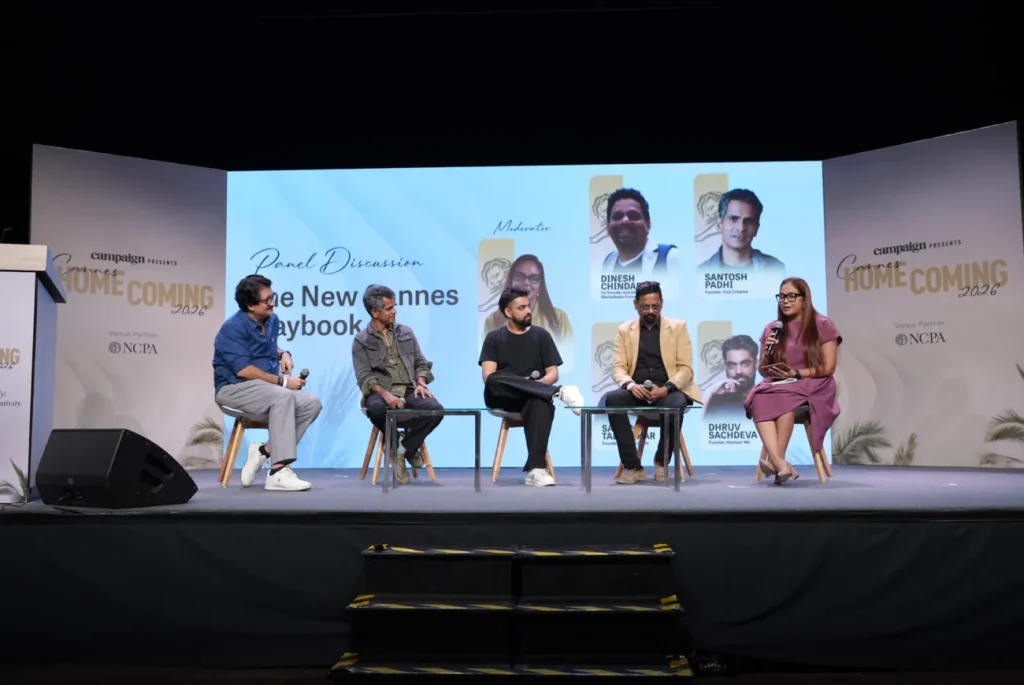
That shift was the starting point for a candid conversation at the second edition of Cannes Homecoming, held on July 10, where industry leaders unpacked what’s really driving the rise of independent shops — and whether it’s a passing moment or a genuine reordering of how creative work gets made and rewarded.
Bravery Over Bureaucracy
Moderating the session, titled “The New Cannes Playbook,” Campaign India editor Vinita Bhatia framed the growing presence of independents as agencies finally stepping out from under the shadow of legacy networks and claiming space they’d long deserved. Building on an earlier panel at the same event — “Ads Ki Adaalat: Putting Cannes on Trial” — she pointed to one word that kept surfacing across both conversations: bravery.
As an example, she pointed to Humour Me’s “Sawaal Uthao” campaign for Tata 1mg, which picked up a Bronze Lion this year. What made the win notable wasn’t just the trophy — it was that this was the agency’s first-ever Cannes entry. Humour Me founder Dhruv Sachdeva explained that the agency had historically stayed out of international award circuits, not out of a lack of ambition, but because its work never felt built for that stage. This year was different because the team believed they’d genuinely cracked a national-scale problem, and that gave them the confidence to put it forward.
Speed as a Competitive Edge
The conversation then turned to why clients are increasingly drawn to independents in the first place. Bhatia posed the sharper question: is this really a structural shift in how the industry works, or simply a byproduct of consolidation among the big networks — smaller pools naturally pushing more independents into view?
Sachdeva’s answer leaned toward the structural. He argued that clients now want lean, agile teams unweighted by legacy hierarchies — teams that can embed themselves in a business problem and build a solution from scratch, rather than routing it through layers of process.
Fellow panelist Talwalkar backed this up with real-world evidence, noting that global brands like BMW and Mercedes often hand individual markets to independent agencies precisely because they can move without getting tangled in extended contracts and sign-off chains. He shared a recent example where his team turned around a client brief in just two meetings — the first to diagnose the problem, the second to present nine possible directions, from which the client immediately zeroed in on two to take forward. That pace, he said, is exactly the kind of value clients are now willing to pay for.
Networks Still Matter — Just Differently
Even as the panel made the case for independents, there was no attempt to write off the networks entirely. Talwalkar was clear that network agencies remain vital as training grounds, pointing out that many independent agency founders — including people in the room — got their start inside big network structures before branching out to build something of their own on their own terms. Sachdeva echoed this, noting that when he and his team built Humour Me, the explicit goal was to do things differently from the systems they’d grown up in, not to reject those systems outright.
Talwalkar also offered a broader read on why the timing favors independents now more than ever. He described Cannes itself as increasingly resembling a martech conference, with consultancies and clients occupying more stage time alongside traditional creative agencies. Within that landscape, independents winning feels significant. Unlike earlier cycles, when a strong independent would often get snapped up by a network soon after making noise, he suggested today’s networks have less appetite — and less capacity — for those acquisitions. That, in his view, gives independents rare room to grow on their own terms.
What It Means Going Forward
The picture emerging from Cannes 2026 isn’t one of independents replacing networks, but of the two operating on more equal footing than before. Independents are winning not because the awards are being handed out more generously, but because clients are actively choosing smaller, faster, less encumbered teams for certain kinds of problems — while still leaning on networks for scale, infrastructure, and talent development.
For an industry that has spent decades organized around size, the real question the panel left hanging isn’t whether independents can keep pace with Cannes. It’s whether Cannes — and the clients who make the festival matter — are now moving at the pace independents have always worked at.
This article is based on discussions from the “The New Cannes Playbook” session at Cannes Homecoming 2026, held on July 10.