Why India Is the World’s Most Confident Consumer Market in 2026

If you want a one-line summary of the Indian economy right now, it’s this: Indians are spending like they believe tomorrow will be better than today — and for once, the global data backs them up. Through most of 2026, India has held the top spot on the LSEG-Ipsos Primary Consumer Sentiment Index (PCSI), a monthly survey that tracks consumer confidence across 30 countries. It’s not a one-off headline. It’s a pattern that’s held for months, even as much of the world — from Japan to Turkey to France — has stayed stuck in cautious or pessimistic territory.
Here’s what’s actually going on, what’s driving it, and where the cracks are starting to show.
The Numbers: India at the Top of the Table
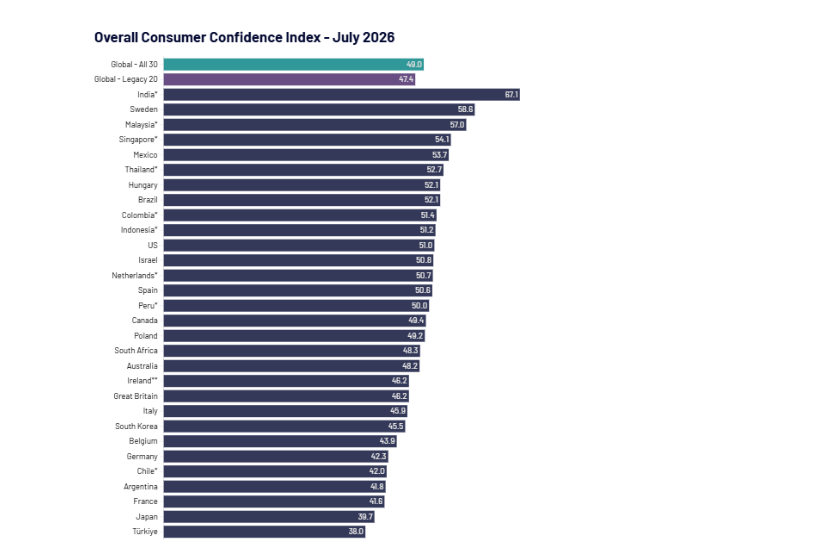
In May 2026, India’s National Index score on the PCSI hit 66.6 — the highest of any of the 30 countries surveyed, and the only one to cross the 60-point threshold that month. Malaysia and Indonesia trailed at 56.7, Sweden at 55.4, and countries like France (39.3), Japan (37.8), and Turkey (35.6) sat well below.
By July 2026, India’s score had climbed further to 67.1, its strongest reading since at least April, and India remained the only country in the survey to stay above 60 for several months running.
Separately, brokerage firm Nuvama’s outlook for 2026 pegged India’s net consumer optimism at 27%, compared to a global average of minus 12% — a gap that puts India second only to China in absolute optimism, but ahead of nearly everyone else by a wide margin. Around 60% of Indian households told Nuvama they expected to increase spending over the following six months, led by big-ticket categories like automobiles (nearly 70% planning higher spend) and mobile devices and plans (63%).
None of this is new for 2026 specifically — India has topped or near-topped this kind of index for years — but the scale of the gap between India and the rest of the world is what’s turning heads this year.
What’s Actually Driving the Confidence
1. A Genuinely Fast-Growing Economy
India’s GDP expanded by more than 8% in recent quarters of FY2025-26, making it the fastest-growing major economy in the world. Late in 2025, India overtook Japan to become the world’s fourth-largest economy at roughly $4.18 trillion, with government estimates suggesting it could overtake Germany for third place by 2030. When people can see the economy growing around them — new infrastructure, more jobs, rising incomes — confidence tends to follow.
2. A Young, Large Workforce
India’s demographic profile is doing a lot of heavy lifting here. A large, young population provides both labor supply and consumption demand — a sharp contrast to aging economies like Japan, where the working-age population is shrinking. A young workforce isn’t just a talking point for economists; it directly shows up as first-time earners, first-time car buyers, and first-time homeowners entering the market every year.
3. The Digital Payments Effect
Digital infrastructure — UPI in particular — has quietly rewired how Indians think about money. Instant, near-free digital payments make spending feel frictionless, and they’ve pulled tens of millions of people into the formal financial system for the first time. Combined with rising personal loan growth and expanding digital financial infrastructure, this has made credit and spending more accessible across income groups, not just for the wealthy.
4. A Rising, More Confident Consumer Class
Deloitte’s ConsumerSignals research describes today’s Indian consumer as standing “at the intersection of optimism and intent” — more discerning, digitally empowered, and financially confident, but also more selective, favoring premium and experience-driven purchases without abandoning value-consciousness. Growing female workforce participation (around 33%, per PwC India) and expanding urbanization are widening the base of consumers who have discretionary income to spend in the first place.
5. Stock Market and Savings Optimism
Buoyant equity markets have a psychological effect that goes beyond the investors who actually hold stocks. When markets are up and business news is positive, it bleeds into how confident the average household feels about its own finances — even before their bank balance changes.
It’s Not All One-Way Traffic
A responsible read of the data means acknowledging the wobbles too, and there have been some.
A Kantar study conducted in May 2026 found that only 48% of Indian consumers expected the economy to improve that year, down sharply from 60% in January. Fears of layoffs rose from 36% to 41% over the same period, and 61% of consumers expected their savings and investments to stay flat or decline compared to 2025.
Separately, an analysis of India’s December 2025 PCSI data noted that while India’s headline confidence remained structurally strong — second among 30 markets that month — the forward-looking components, particularly jobs and expectations, softened noticeably. The takeaway from that analysis was a useful one: don’t treat “consumer confidence” as a single number. It’s closer to a balance sheet with several line items, some of which are far more stable than others.
In short: the top-line story is real, but it’s not uniform. Indian consumers are confident about the big picture — the economy’s direction, the country’s global standing, their own long-term prospects — while staying more cautious about jobs and near-term personal finances. That’s a more nuanced, and more believable, picture than a simple “India is unstoppable” headline.
What This Means for Brands, Retailers, and Investors
For businesses operating in or eyeing the Indian market, a few practical implications stand out:
- Discretionary categories are where the money is moving. Autos, mobile devices, and mobile plans are leading spending intent — signals worth tracking closely if you’re in retail, telecom, or auto-adjacent sectors.
- Premiumization is real, but value still matters. Indian consumers are trading up on experiences and premium products while remaining price-conscious on essentials — a “stretch value, not compromise on aspiration” mindset, as Deloitte’s Anand Ramanathan put it.
- Watch the jobs data, not just the headline index. If employment expectations keep softening the way they did between January and May 2026, expect more trade-down behavior and a more promotional retail environment even if headline confidence stays high.
- Foreign investor interest is following the demand story. Deals like Haldiram’s $1.5 billion transaction at a $10 billion valuation show global capital is already positioning around India’s consumption growth, not just its GDP growth.
The Bottom Line
India’s status as the world’s most confident consumer market isn’t a fluke of one survey or one month — it’s been a consistent theme across LSEG-Ipsos, Nuvama, and Mastercard data over an extended stretch, backed by real structural drivers: fast GDP growth, a young workforce, digital financial inclusion, and a widening base of discretionary spenders.
At the same time, the confidence isn’t blind optimism. Indian consumers are watching jobs, inflation, and their own savings closely, and sentiment has shown it can soften month to month even while staying at the top of the global table. That combination — structurally high confidence with a realistic, watchful eye on near-term risks — is arguably a healthier signal than pure euphoria would be.
For now, though, the headline stands: when the rest of the world is nervous, India is one of the very few places still willing to bet on itself.
Data referenced from LSEG-Ipsos Primary Consumer Sentiment Index (2026), Nuvama consumer outlook report (2026), Kantar consumer confidence study (May 2026), Deloitte ConsumerSignals India (2025), PwC India, and Reserve Bank of India Consumer Confidence Survey.
Frequently Asked Questions
Is India really the most confident consumer market in the world? Based on the LSEG-Ipsos PCSI, which tracks 30 major economies monthly, India has held the top National Index score for several consecutive months through 2026, making it the most confident market by that specific measure.
Why are Indian consumers so confident? Key drivers include India’s fast GDP growth (8%+ in recent quarters), a young and expanding workforce, widespread digital payment adoption (UPI), rising personal loan and credit access, and a growing base of urban, digitally-savvy consumers with discretionary income.
Is Indian consumer confidence at risk of declining? Some surveys, including Kantar’s May 2026 study, show softening sentiment around jobs and personal savings even as headline confidence remains high — suggesting the picture is strong but not uniformly positive.