Warsaw Stage: Poland’s Capital Unveils the Largest 3D LED Screen in Europe

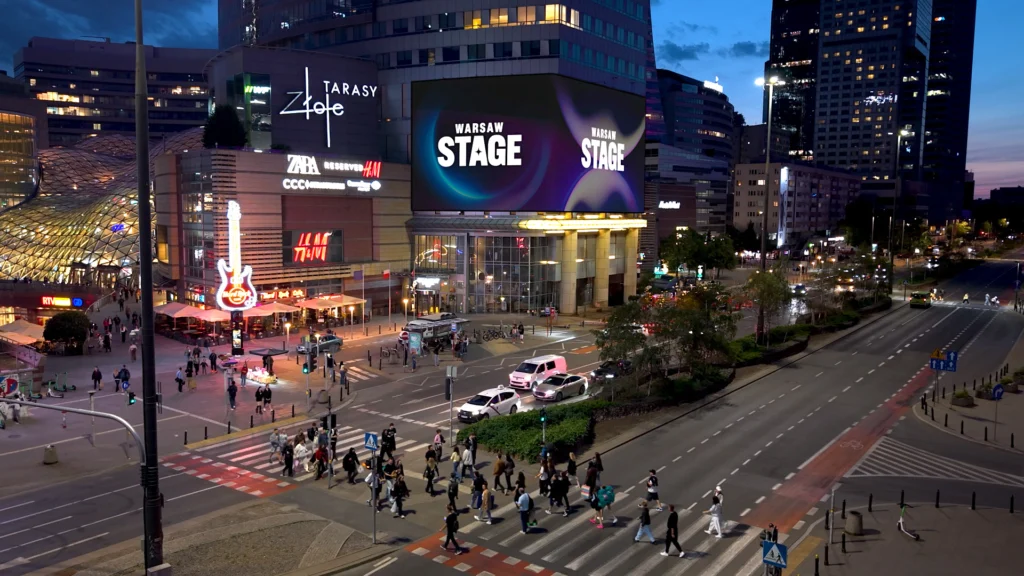
Warsaw, July 2026 — Warsaw has a new landmark, and it’s impossible to miss. Warsaw Stage, a three-sided, immersive LED screen wrapped around the Skylight tower at the entrance to the Złote Tarasy (Golden Terraces) shopping and business complex, has officially gone live in the heart of the city. According to its operator, the digital advertising company Digital Network, it is now the largest LED screen in Europe — bigger than London’s iconic Piccadilly Lights — and the biggest such installation in Poland.
What Is Warsaw Stage?
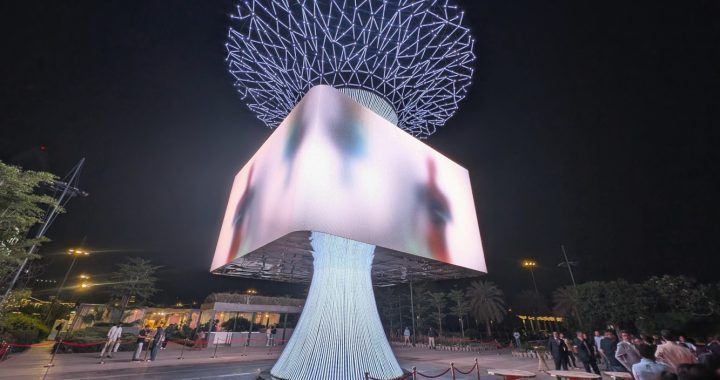
Warsaw Stage is a curved, three-sided digital display covering more than 800 square metres of LED surface. The installation is built from nearly 1,000 LED cabinets, weighing around 22 tonnes in total, mounted on a steel support structure of roughly 84 tonnes of structural steel, complemented by close to 6 tonnes of hot-dip galvanised coating and mounting components. Wiring the display required nearly 10 kilometres of cable.
Unlike a flat billboard, Warsaw Stage wraps around three faces of the Skylight tower, allowing brands and artists to run synchronized content across all three surfaces at once. That geometry is what makes the screen suited to 3D anamorphic creations — the illusion-style animations, popularized on screens like Piccadilly Lights and Seoul’s Gangnam district displays, where objects appear to break out of the screen toward viewers.
Damian Rezner, Board Member and Chief Operating Officer of Screen Network SA, the company responsible for the technical build, described the construction as one of the most complex engineering challenges the group has undertaken: the real difficulty was merging three separate surfaces into a single, seamless stage for 3D content, where every detail — from the steel frame to installation safety in the middle of a dense city centre — mattered.
A Prime Location: The Heart of Warsaw
Location is central to Warsaw Stage’s pitch to advertisers. The screen sits at one of the busiest and most recognisable intersections in Poland, surrounded by:
- Warsaw Central Railway Station (Dworzec Centralny), used by an estimated 20 million passengers a year
- Warszawa Śródmieście railway station
- Centrum metro station
- Varso Tower, the tallest building in the European Union
- The InterContinental Hotel and Złota 44 residential tower
- The Palace of Culture and Science, a landmark public square used for cultural and sporting events
The immediate surroundings include roughly 200 shops, 40 restaurants, 16 cinema screens and two theatres, giving Warsaw Stage guaranteed daily footfall from commuters, shoppers, tourists and office workers alike.
“Warsaw Gets Its Own Times Square”
Digital Network is positioning Warsaw Stage as more than an advertising panel — as a new cultural and media landmark for the city. Agnieszka Godlewska, President of the Management Board at Digital Network, said the screen is meant to become a new, world-scale outdoor digital stage for Warsaw (hence the name “Stage”) — a premium format built for brands and events that want to be present where luxury, business, tourism and city life intersect.
Godlewska also framed the investment as something distinct from a typical billboard network, arguing that while a large screen network delivers reach, an iconic large-format screen in a city centre delivers something more: attention, prestige, PR potential and the ability to turn a brand campaign into a media event that spreads through social media.
The comparison companies keep returning to is Times Square in New York, Piccadilly Circus in London, and the Gangnam district in Seoul — cities whose oversized digital screens have themselves become tourist attractions and shorthand for a “world city.” With Warsaw Stage, Digital Network is explicitly positioning Warsaw as joining that club, and describes the launch as the company’s largest single investment yet in the super-premium outdoor advertising segment.
Digital Network, listed on the Warsaw Stock Exchange (GPW), already operates Poland’s largest outdoor digital advertising network, with more than 20,000 LED and LCD screens across city streets, shopping centres, railway stations and office buildings. Warsaw Stage is designed to sit at the top of that network as a flagship, standalone media format rather than just another screen.
Not Everyone Is Cheering
The launch hasn’t been universally welcomed. Since renderings and early footage of Warsaw Stage began circulating, some Warsaw residents, urban-planning commentators and journalists have criticised the screen as visual clutter in a historically sensitive part of the city, with some social media reactions calling it an eyesore and questioning whether it complies with the city’s landscape and advertising regulations. Critics argue the area around the Palace of Culture and Science should lean toward green space and public gathering rather than another large advertising surface, while supporters counter that large-format digital “stages” are now standard infrastructure in major global cities and a natural evolution of outdoor media.
That tension — between city branding ambition and concerns over visual pollution — is likely to shape public debate around Warsaw Stage as much as the campaigns that eventually run on it.
Why It Matters for Brands and Marketers
For marketers, Warsaw Stage represents a shift in what outdoor advertising in Poland can do. Its pitch centres on three things a standard billboard can’t offer:
- Scale and spectacle — an 800+ m² wraparound canvas large enough for immersive 3D creative that can’t be “scrolled past.”
- Prestige location — guaranteed visibility among the highest foot-traffic and highest-profile audiences in the country.
- Earned media potential — campaigns designed to be filmed by passersby and shared on social media, extending a single activation well beyond its physical airtime.
Digital Network describes this as campaigns that don’t end where they’re displayed — they begin there, then continue living on in passersby’s phones, trade media, and brands’ own long-term communications.
The Bigger Picture: Europe’s Race for Iconic Screens
Warsaw Stage arrives as outdoor advertising globally shifts away from static billboards toward large-format digital “stages” that blend advertising, art and spectacle. From Piccadilly Lights in London to the Sphere in Las Vegas, cities and operators are betting that a single unmissable digital landmark can generate more brand value — and more media coverage — than dozens of conventional ad placements combined. With Warsaw Stage, Warsaw becomes the latest European capital to make that bet, and, according to Digital Network, currently the biggest screen of its kind on the continent.
FAQ: Warsaw Stage
How big is Warsaw Stage? The screen covers more than 800 square metres across three sides of the Skylight tower, built from nearly 1,000 LED cabinets on an 84-tonne steel structure.
Where exactly is Warsaw Stage located? At the Skylight tower, at the entrance to the Złote Tarasy complex in central Warsaw, next to Warsaw Central Station, Warszawa Śródmieście station, the Centrum metro stop, Varso Tower and the InterContinental Hotel.
Who built and operates Warsaw Stage? It was developed by Digital Network, Poland’s largest outdoor digital advertising operator, with the technical build carried out by Screen Network SA.
Is Warsaw Stage really bigger than Piccadilly Lights? According to Digital Network, yes — the company states Warsaw Stage’s surface area exceeds that of London’s Piccadilly Lights, making it the largest such screen in Europe as of its 2026 launch.
What kind of content will appear on Warsaw Stage? Digital Network says the screen is designed for brand launches, special ad campaigns, 3D anamorphic creative, cultural and artistic events, and product premieres.
Sources: Digital Network and Screen Network press materials; reporting from Media2.pl, Brief.pl, Signs.pl, AboutMarketing.pl, Inwestycje.pl, Strefa Biznesu, NowaWarszawa.pl and Spider’s Web (July 2026).