Global OOH Advertising Hits $54.2 Billion in 2025, Set to Climb to $56.4 Billion in 2026

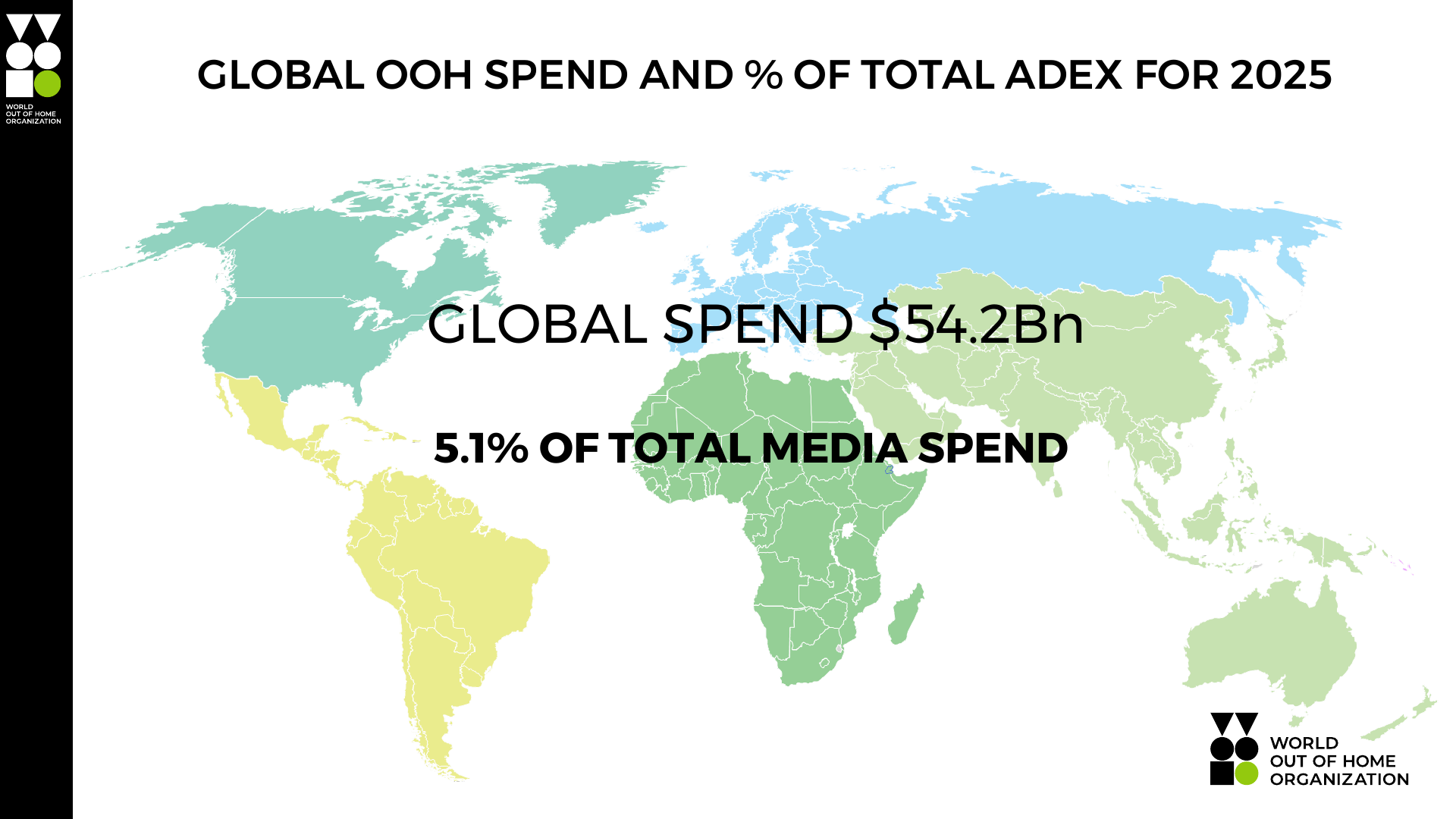
Out-of-home advertising just posted one of its strongest years in recent memory. According to the newly released 2026 WOO Global Out of Home Expenditure Report, global OOH spending grew 15% year-on-year to $54.2 billion in 2025, accounting for 5.1% of worldwide advertising spend. The industry isn’t slowing down either — WOO expects the medium to reach $56.4 billion in 2026, driven largely by the continued expansion of digital out-of-home (DOOH).
The report comes from the World Out of Home Organization (WOO), the global trade body for the OOH industry, and is widely regarded as the most comprehensive benchmark for the sector. This year’s edition is based on responses from more than 100 industry participants across 85 markets, representing around 95% of global GDP, giving the numbers real credibility as a global snapshot rather than a regional estimate.
A medium on a genuine upswing
A 15% jump in a single year is a big number for an established ad channel, especially one that’s been around for over a century. It suggests OOH is finding fresh relevance in a media landscape increasingly crowded by streaming, social, and retail media. Part of that resilience comes down to something OOH has always had going for it: it can’t be skipped, blocked, or muted.
Digging into the country-level data, WOO’s report found that some of the medium’s healthiest performances came in markets you might not expect to lead the pack. Brazil, China, and South Korea registered among the strongest OOH shares in their respective overall advertising markets — meaning OOH is punching above its weight there relative to other ad channels.
Digital is doing the heavy lifting
If there’s one storyline running through this report, it’s digital out-of-home’s steady takeover of the category. Global DOOH expenditure rose to $25.5 billion in 2025, accounting for 47% of total OOH revenues, and WOO doesn’t expect that momentum to fade. The organization expects DOOH to contribute 49% of global OOH revenues in 2026, reaching $28 billion and potentially overtaking static OOH for the first time — a genuine milestone for an industry that, not long ago, was still dominated by paper posters and static billboards.
Digital adoption, though, isn’t even across the world. Regionally:
- Asia-Pacific leads by a wide margin, with DOOH accounting for 55.7% of OOH revenues
- North America at 36.9%
- Latin America at 27.7%
- Africa trails at 18%
That spread tells its own story about infrastructure investment and regulatory readiness — APAC’s dominance is largely thanks to China’s scale, while Africa’s lower digital penetration points to a market still building out the physical screen network needed to go digital.
Programmatic is small but growing fast
One of the more closely watched numbers in this year’s report is programmatic DOOH — media bought and sold automatically through ad-tech platforms rather than negotiated deal-by-deal. Programmatic DOOH generated $2.1 billion globally in 2025, representing 8.4% of total DOOH revenue worldwide.
It’s still a small slice of the overall pie, but the direction of travel matters more than the size right now. To sharpen the accuracy of that number going forward, WOO has launched an independently audited survey of leading global supply-side platforms in partnership with PwC to improve the consistency of programmatic measurement across markets — a sign the industry is trying to bring the same rigor to OOH measurement that digital and social channels have had for years.
Who’s spending the most
Breaking down spend by region, Asia-Pacific continued to account for the largest share of global OOH spending, at USD 29.7 billion, or roughly 55% of the global market. North America followed with USD 10.3 billion, just ahead of Europe at USD 10.2 billion, then Latin America at USD 2.9 billion and Africa at USD 1.2 billion.
At the country level, the ranking is much the same as in past years: China remained the world’s largest OOH market with spending of USD 18.2 billion, followed by the United States at USD 9.5 billion and Japan at USD 3.2 billion. Other markets rounding out the leaderboard included the United Kingdom, Germany, France, Brazil, South Korea, Australia, and Italy.
Why this matters
For brands and media planners, the takeaway is straightforward: OOH is no longer the “reach and frequency” channel it once was — it’s becoming a data-driven, digitally traded medium that behaves more and more like other performance channels. For the industry itself, better measurement (especially around programmatic) means it can compete more credibly for ad budgets that have historically gone to digital-first channels.
With DOOH on track to overtake static formats for the first time in 2026, the next year’s report may well mark a genuine turning point for how out-of-home advertising is bought, sold, and measured globally.
Source: 2026 WOO Global Out of Home Expenditure Report, World Out of Home Organization (WOO), released July 2026.