Future of DOOH Advertising: Insights from e4m OOH Conference 2026

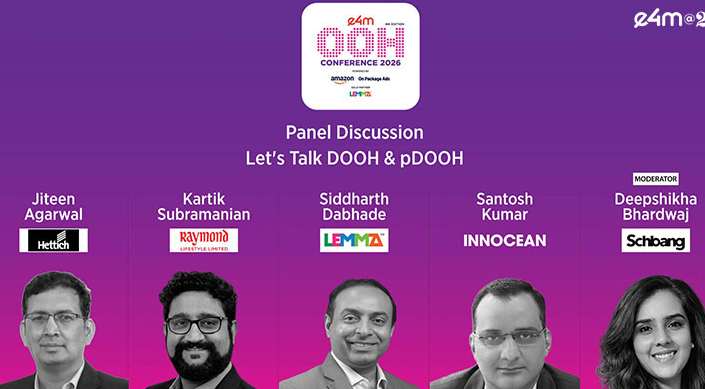
At the e4m OOH Conference 2026, one theme stood out clearly—Digital Out-of-Home (DOOH) and programmatic DOOH (pDOOH) are no longer emerging channels; they are actively reshaping how brands engage audiences through data, storytelling, and real-time intelligence. A high-impact session titled “Let’s Talk DOOH & pDOOH”, moderated by Deepshikha Bhardwaj, brought together leading voices including Jiteen Agarwal, Kartik Subramanian, and Siddharth Dabhade—offering a grounded view of how brands are navigating this evolving medium.
DOOH: From Constraint to Strategic Channel
Opening the discussion, Bhardwaj positioned programmatic DOOH as a powerful hybrid—combining the scale of outdoor media with the precision of digital targeting. This dual advantage allows marketers to deliver the right message at the right moment, but it also raises a key question: are brands adopting DOOH out of necessity or innovation?
For Raymond, the answer was clear. Subramanian shared that their initial move into DOOH was not driven by experimentation but by limited availability of traditional outdoor inventory near retail locations. However, what started as a fallback soon proved its value.
In high-density markets like Mumbai, DOOH has emerged as a more accessible and flexible option in premium catchment areas, gradually earning its place in the brand’s media mix. Yet, he pointed out a critical gap—many brands still fail to unlock the medium’s storytelling potential, often using DOOH like static carousel ads rather than dynamic narratives.
Storytelling Meets Motion: A Creative Advantage
For visually rich brands like Raymond, DOOH has opened new creative frontiers. Subramanian emphasized how motion-led displays bring garments to life—capturing drape, texture, and detail in ways traditional billboards simply cannot.
Agarwal echoed this sentiment from a different category perspective. For Hettich India, where products are designed around movement, static formats fall short. DOOH, therefore, becomes not just an option but a necessity for effective storytelling.
He highlighted that impactful DOOH campaigns require concise, engaging storytelling within 10–15 seconds, especially in environments where attention spans are limited.
Programmatic DOOH: Bringing Digital Precision to Outdoor
Shifting focus to programmatic, Dabhade simplified the concept by comparing it to a stock exchange for advertising—where media inventory is bought and sold in real time through automated platforms.
This transformation introduces transparency, control, and accountability into a medium that has traditionally struggled with measurement. Advertisers can now track campaign delivery across hundreds or thousands of screens, ensuring they only pay for verified impressions.
More importantly, programmatic DOOH enables audience-first planning, allowing brands to target specific consumer segments rather than just locations—bringing outdoor advertising closer to digital performance marketing.
Data, Retargeting & Full-Funnel Impact
One of the most significant advancements discussed was DOOH’s expanding role across the marketing funnel. Through geofencing and mobile data integration, brands can now retarget audiences exposed to DOOH campaigns, driving them toward measurable actions such as app installs, store visits, or purchases.
This shift positions DOOH as more than just an awareness tool—it becomes a performance-driven channel with tangible ROI.
Challenges: Measurement, Fragmentation & Visibility
Despite its promise, the ecosystem still faces operational challenges. Agarwal pointed to the lack of real-time dashboards, inconsistent reporting, and vendor fragmentation as key hurdles.
Measurement remains a grey area, with traditional metrics like impressions or OTS offering limited insight into actual business outcomes. Brands are increasingly demanding stronger attribution models, including footfall tracking and brand lift analysis.
Additionally, the lack of structure in non-metro markets continues to create uncertainty, highlighting the need for more organized networks and reliable aggregators.
The Visibility Dilemma in DOOH
Subramanian also raised concerns about actual visibility in fast-moving environments. With ads often running in short loops, the real opportunity to capture attention can be significantly lower than reported metrics suggest.
This creates a gap between investment and impact, especially when compared to more controlled digital environments. Increasing share of voice can solve this—but at a higher cost, challenging the perception of DOOH as a budget-friendly medium.
Global Inspiration & Creative Evolution
Looking beyond India, Subramanian noted that markets like Southeast Asia are already embracing DOOH-first creative strategies, with bold, motion-driven executions designed specifically for digital screens.
The takeaway is clear: creative quality is critical. Without engaging, context-relevant content, even the most advanced DOOH placement risks underperforming.
AI & The Next Phase of DOOH Innovation
Dabhade highlighted the growing role of artificial intelligence in programmatic DOOH, from automated planning to dynamic creative optimization. Campaigns can now adapt in real time—responding to weather, live events, or even sports scores through API integrations.
This evolution is paving the way for a more connected ecosystem, where data, screens, and automation work seamlessly together to deliver hyper-personalized experiences.
Future Outlook: Inevitable, Yet Evolving
When asked about the future, the panel offered a balanced perspective. Agarwal described programmatic DOOH as “inevitable,” driven by the broader shift toward automation and efficiency in media buying.
Subramanian, however, urged caution, noting that brands are still in the early stages of understanding the medium and its full potential.
Dabhade summed it up with a forward-looking view: the future isn’t just programmatic—it’s AI-led programmatic DOOH that will define the next era of advertising.
DoohDigital Perspective
At DoohDigital, we see DOOH not just as a channel, but as a convergence point of creativity, data, and technology. As infrastructure matures and measurement improves, brands that embrace audience-first planning, dynamic storytelling, and AI-driven optimization will unlock the true power of this medium.
The future of advertising isn’t just digital—it’s contextual, connected, and screen-driven. And DOOH is right at the center of it.