Tata Sierra, Cadbury Dairy Milk Lead the Pack: Inside Ormax’s IPL 2026 Brand Impact Rankings

Six brands turned cricket’s biggest stage into measurable business impact — but no two of them got there the same way
Every IPL season produces a familiar storyline: hundreds of crores spent, dozens of brands jostling for eyeballs, and a broadcast calendar so cluttered that most sponsorships blur into background noise by the time the trophy is lifted. IPL 2026 was no exception on volume. But a new study from Ormax Media suggests that money and mentions alone didn’t determine who actually won the season.
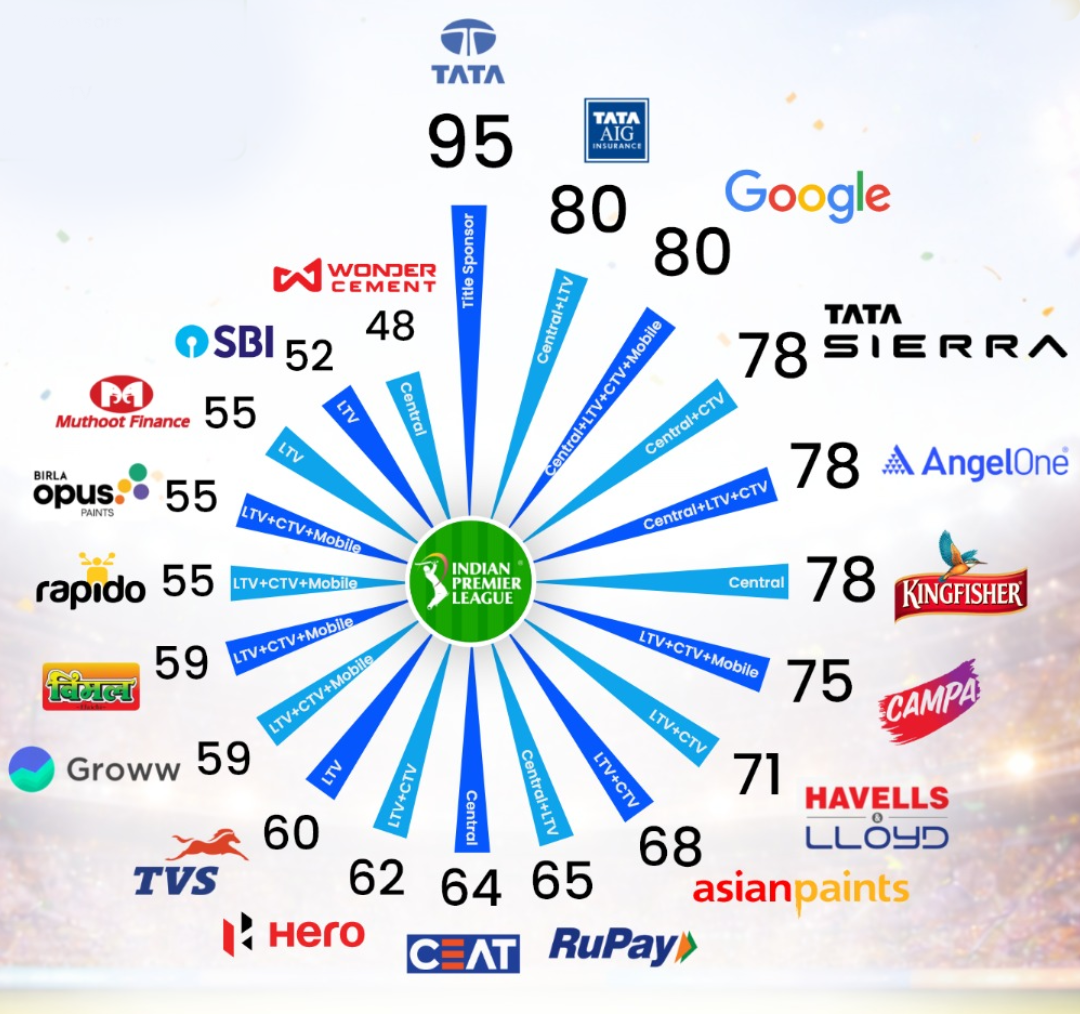
According to Ormax Trac20: Ad & Sponsorship Effectiveness Research for IPL 2026, six brands — Tata Sierra, Cadbury Dairy Milk, Tata AIG, Rapido, Google AI Mode, and Wonder Cement — stood out as the biggest beneficiaries of their association with the tournament. They recorded the highest Ormax Mpact Scores among 54 brands evaluated in the study, a distinction Ormax says reflects genuine shifts in consumer perception rather than just visibility.
How Ormax measured “impact” instead of just “reach”
Most cricket sponsorship reporting during IPL season revolves around a single currency: ad volume — how many seconds of airtime a brand bought, how many mentions it got, how many times its logo flashed across the screen. Ormax Trac20 was built to answer a different question: did any of that actually move the needle on how consumers think about the brand?
The tool behind the ranking, Ormax Mpact, is Ormax Media’s proprietary brand-lift measurement framework. Rather than tracking exposure, it calculates a single, benchmarkable score based on statistically significant movement across five brand health indicators:
- Top-of-mind awareness
- Spontaneous awareness
- Total awareness
- Consideration
- Purchase or usage intent
To capture this movement, Ormax ran a large-scale, two-phase study: 15,000 online interviews in total, split evenly into 7,500 conducted before the IPL season began and 7,500 conducted after it concluded. Each of the 54 participating brands was independently evaluated among 300–500 consumers from its relevant target audience, in both the pre- and post-tournament phases — allowing Ormax to isolate the actual “lift” a brand experienced as a direct result of its IPL association.
The research also wasn’t confined to metro bubbles. It covered urban India broadly, spanning IPL franchise home cities as well as other major commercial markets, including metros, mini-metros and smaller towns — giving the findings reach across the country’s core cricket-viewing and consuming base.
Beyond the individual brand rankings, the report also benchmarks the effectiveness of different types of cricket association — title sponsorship, tournament sponsorship, in-match and in-stadium branding, commentary-led integrations, franchise sponsorship, and conventional spot advertising — a comparison Ormax says is designed to help brands and agencies make sharper calls not just on IPL spending, but on cricket advertising more broadly, including international fixtures and other major tournament properties.
The six standout brands — and six different playbooks
What makes the findings notable isn’t just who topped the list, but how differently each of the six got there. As Ormax’s own analysis points out, their strategies were “anything but identical.”
Tata Sierra — Title sponsorship, stacked
Tata Sierra didn’t rely on one lever; it pulled several simultaneously. The brand combined title sponsorship with heavy in-stadium visibility, regular commentary mentions, and a high-profile role as the official trophy car for the final — a moment of guaranteed, high-attention screen time. Layered on top was its ‘Escape Mediocre’ brand campaign, giving the sponsorship a consistent creative narrative rather than just a logo presence. Independent TAM Sports data on IPL 2026 ad volumes backs up the scale of this push — Tata Sierra featured among the top five most-advertised brands on Connected TV during the season, alongside the likes of Google Gemini and Maruti Suzuki’s e Vitara.
Cadbury Dairy Milk — Making the sponsorship personal
Rather than leaning purely on broadcast weight, Cadbury Dairy Milk built its campaign around an experiential idea: ‘The Khaas Seat.’ Conceptualised with Ogilvy and executed in partnership with Mumbai Indians, the initiative created a dedicated section at Wankhede Stadium reserved for fans attending an IPL match for the very first time. It’s a campaign built on emotional resonance rather than sheer frequency — turning a sponsorship into a shareable, story-driven experience rather than a wallpaper of logos.
Tata AIG — Embedding inside the broadcast itself
Tata AIG’s approach centred on its ‘Fan Box’ activation, integrated directly into the live match viewing experience rather than running alongside it. This was reinforced with regular commentary mentions and a supporting campaign that ran across both television and streaming platforms — an approach designed to keep the insurance brand present in-context, at the moments viewers were most engaged.
Rapido — Broadcast scale plus a tangible offer
As an official broadcast sponsor across JioHotstar and Star Sports, Rapido had access to considerable reach by default. What set its campaign apart was pairing that visibility with a concrete consumer incentive — the ‘First Ride Free’ campaign — giving viewers an immediate, low-friction reason to act on the brand recall the sponsorship generated.
Google AI Mode — Using cricket to introduce a new product
Google AI Mode took a slightly different route: using the cultural moment of cricket to familiarise a mass audience with a relatively new product — its AI-powered search experience. The brand leaned on contextual cricket integrations and references woven into commentary, effectively using the sport as a soft-launch platform rather than a straightforward ad buy. This tracks with the wider TAM Sports finding that Google was the single largest advertiser of IPL 2026 by volume across both Linear TV and Connected TV, with Google Search Engine and Google Gemini both ranking among the season’s most-advertised individual brands.
Wonder Cement — Owning a moment fans already care about
Wonder Cement built its campaign around a role fans are conditioned to pay attention to: Official Umpire Partner. That status was paired with in-match branding tied specifically to DRS decisions — a moment of natural viewer tension and focus — and reinforced by its ‘Farq Nazar Aayega’ campaign. The strategy is a reminder that a well-chosen, high-attention moment in the broadcast can outperform generic omnipresence.
What Ormax says the six have in common
Despite the diversity of approach — a title sponsorship here, an experiential activation there, a product-introduction play elsewhere — Ormax’s leadership sees a common thread running underneath.
Keerat Grewal, Head of Business Development (Streaming, Television & Brands) at Ormax Media, framed the finding this way: cricket delivers exceptional scale, but scale by itself does not guarantee brand impact. According to Grewal, what united the six strongest performers wasn’t the format of their association but the discipline behind it — clear messaging, contextual relevance, and consistent reinforcement across multiple consumer touchpoints throughout the tournament.
In other words: the brands that won weren’t necessarily the ones that spent the most or appeared the most often. They were the ones whose IPL presence told a coherent, repeated story that consumers could actually retain.
The backdrop: a more concentrated, more competitive ad season
The Ormax findings arrive alongside a separate piece of the puzzle from TAM Sports, whose IPL 2026 Commercial Advertising Report offers useful context on just how crowded — and how consolidated — this year’s advertising battlefield actually was.
Despite fewer players competing for attention, overall ad intensity actually increased. TAM Sports found that the average ad volume per channel per match across IPL 2026’s 74 live matches rose roughly 4–5% over IPL 2025, and was about 5% higher than IPL 2024. Yet this growth came even as the ecosystem itself shrank: the number of advertising categories fell from over 70 to just over 60, the number of individual advertisers dropped from more than 110 to roughly 65–85, and the number of active brands fell from over 200 to around 125.
The takeaway, according to TAM Sports, is that fewer brands fought for a still-growing pool of ad inventory — meaning the ones who stayed in the game effectively bought greater share of voice and less clutter to cut through. That’s the exact environment in which the Ormax Trac20 findings make sense: with fewer competitors diluting attention, the brands that paired real spend with a distinctive creative or experiential idea had a cleaner runway to register with consumers.
It’s also worth noting that Google’s dominance in raw ad volume (it was the single largest advertiser across both Linear TV and CTV per TAM Sports) didn’t automatically translate into Ormax’s Mpact rankings — it was specifically Google AI Mode, a targeted product push riding on that broader Google presence, that made the Ormax cut, not Google’s overall advertising weight. That distinction reinforces Ormax’s central argument: spend and reach are necessary, but not sufficient, for brand impact.
Why this matters beyond IPL 2026
For marketers, the report’s real value may lie less in the specific leaderboard and more in what it implies about sponsorship strategy going forward. Ormax Trac20 was introduced this season as what the company describes as the largest syndicated research initiative focused on sponsorship and advertising effectiveness for the IPL — built on a dual-framework structure that combines a weekly ad-tracking module through the season with the three-stage Mpact brand-lift measurement across pre-season, mid-season and post-season checkpoints.
Shailesh Kapoor, Founder & CEO of Ormax Media, has previously described the rationale behind the initiative in similarly direct terms: the IPL is India’s biggest advertising stage, but it is also expensive and highly cluttered — which means brands need more than visibility metrics to judge whether their investment is actually paying off.
The full Ormax Trac20 report, including the complete brand-by-brand breakdown and comparison of sponsorship formats, is available through subscription.