The Swatch x AP Queues Were Never About the Watch

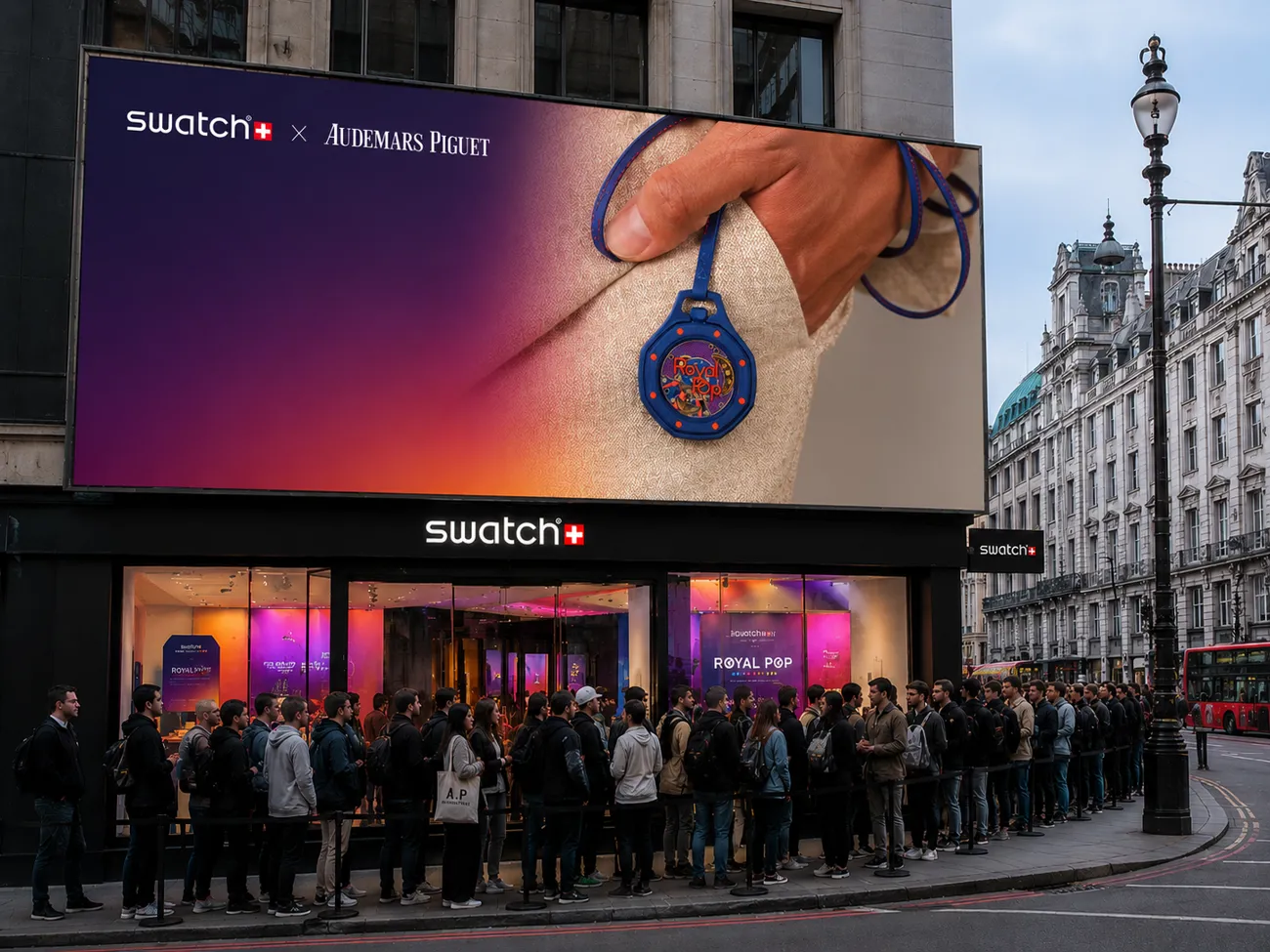
The scenes outside Swatch stores around the world this month looked less like a luxury watch launch and more like a sneaker drop festival. Crowds camped overnight. Police intervened in several cities. Stores shut down due to safety concerns. Yet the biggest story was not the colorful $400 pocket watch itself — it was what the chaos revealed about the future of luxury branding. The collaboration between Swatch and Audemars Piguet introduced the “Royal Pop,” a playful pocket-watch collection inspired by AP’s legendary Royal Oak design. The collection blended Swatch’s mass-market accessibility with AP’s ultra-exclusive identity.
But what people were really lining up for was not a timepiece.
They were lining up for proximity to a dream.
For decades, luxury brands protected exclusivity by keeping entry barriers high. Audemars Piguet, known for producing some of the world’s most desirable luxury watches, has historically catered to a small elite audience. A standard Royal Oak can cost tens of thousands of dollars, putting it far out of reach for most consumers. The Swatch collaboration changed that equation — not by making AP affordable, but by making the brand emotionally accessible.
This is where the strategy becomes fascinating.
Unlike traditional diffusion lines that risk weakening a luxury label, AP is betting on aspiration over ownership. The company understands that younger consumers may never buy a full-priced Royal Oak today, but they still want to participate in the culture surrounding it. Owning a Swatch collaboration gives them a ticket into that world.
The same playbook transformed sneaker culture. Limited-edition collaborations created communities, online conversations, and resale economies where hype became more valuable than utility. The Swatch x AP launch followed the same formula: scarcity, social media buzz, resale frenzy, and viral visibility.
The resale market exploded almost immediately. Some watches flipped online for several times their retail price within hours of launch day. Long queues and global sellouts only intensified the perception that the collaboration was culturally important.
Critics argue that this kind of mass-market collaboration risks diluting AP’s carefully crafted prestige. Luxury has traditionally depended on distance — the idea that not everyone can participate. Some collectors fear that aligning with Swatch could make the brand feel less rare.
Yet history suggests the opposite may happen.
When Swatch collaborated with Omega on the MoonSwatch, interest in the original Speedmaster reportedly increased rather than declined. Industry analysts now believe the AP collaboration could create a similar “halo effect,” where affordable access strengthens desire for the real thing instead of replacing it.
In many ways, Audemars Piguet is not selling watches anymore.
It is selling participation.
Luxury brands are increasingly realizing that younger audiences value cultural belonging as much as ownership. Social media has shifted luxury from private consumption to public identity. Consumers want to engage with the mythology of brands long before they can afford their flagship products.
That is why the Swatch x AP queues mattered.
The people waiting overnight were not simply buying a pocket watch. They were buying closeness to a luxury narrative — a way to touch a world that usually exists behind velvet ropes.
And that may become the defining luxury strategy of the next decade.
If Audemars Piguet succeeds, other heritage brands could follow the same model: protect the ultra-premium core while opening controlled, hype-driven entry points for younger consumers. Luxury would no longer depend entirely on exclusivity through price. Instead, it would thrive through cultural relevance, scarcity, and emotional access.
The watch world may never look at “affordable luxury” the same way again.