Future of Streaming in India: Pricing Hikes, Ad-Tiers, and Profit Margins

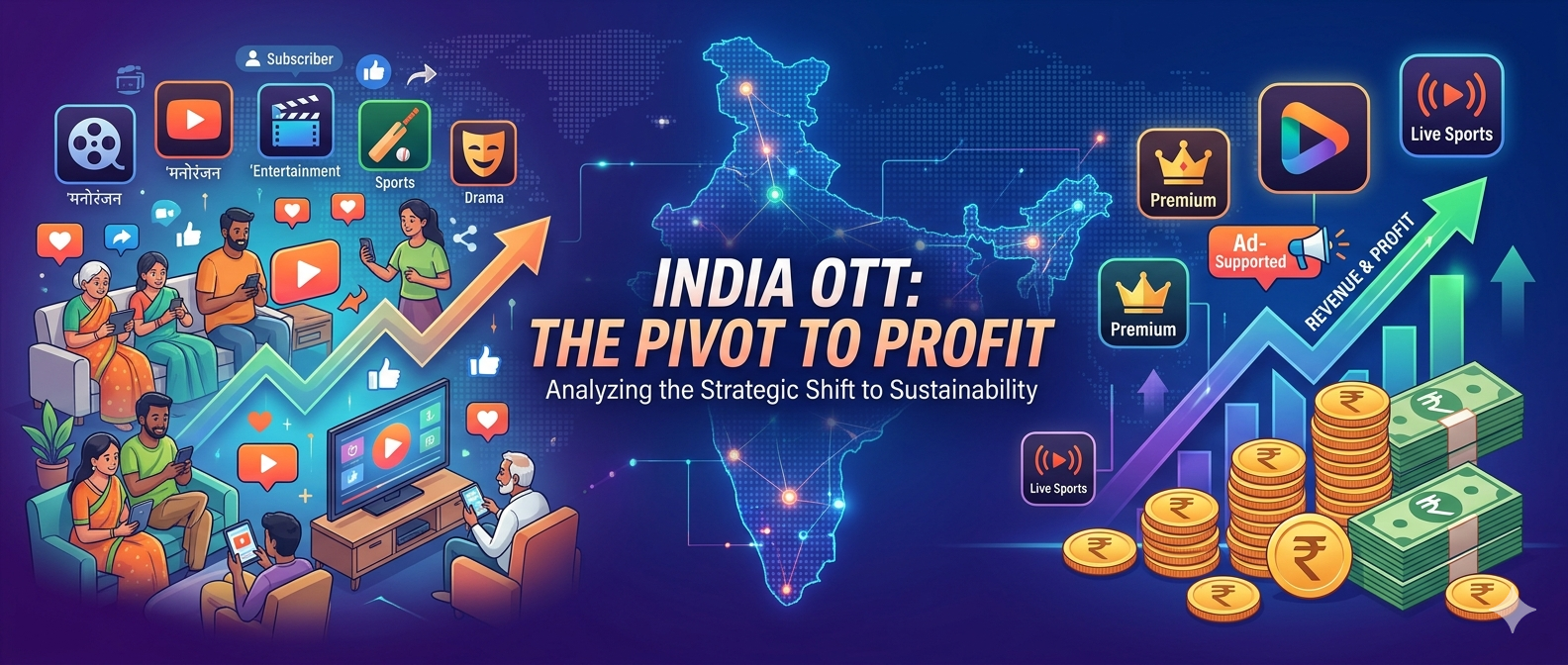
The “Subscriber War” that defined the Indian streaming landscape for nearly a decade has officially ended. In its place, a new era has emerged: The Era of Sustainable Profitability.
For years, Indian OTT (Over-The-Top) platforms operated on a “growth at all costs” model, burning billions in venture capital and corporate reserves to capture a share of India’s 600-million-plus digital video audience. However, as of April 2026, the industry has reached a definitive inflection point.
Here is a detailed look at how India’s OTT giants have pivoted toward the black.
1. The Financial Turnaround: From Red to Black
The most striking evidence of this shift lies in the recent financial disclosures for the fiscal year 2025-26.
-
Netflix India: Often the benchmark for SVOD (Subscription Video on Demand) success, Netflix India reported a staggering 63% surge in net profit to $₹85$ crore for FY25. With revenues crossing $₹3,700$ crore, the platform proved that a premium-only, high-ARPU (Average Revenue Per User) strategy could indeed scale in a price-sensitive market.
-
JioHotstar (The JioStar Era): Following the massive merger of Disney+ Hotstar and JioCinema, the new entity has become a profit powerhouse. In Q3 of FY26 alone, JioStar reported a Profit After Tax (PAT) of $₹888$ crore, with a 9-month PAT reaching $₹2,791$ crore. This scale is unprecedented in the Indian digital ecosystem.
2. Strategic Consolidation: Strength in Numbers
The “Great Consolidation” of 2025 was the primary catalyst for profitability. By merging competing platforms, companies eliminated “content bidding wars” that previously drove licensing costs to unsustainable levels.
-
Content Synergy: The JioHotstar merger allowed for a unified library covering everything from HBO and Disney originals to the IPL and domestic soap operas.
-
Reduced Overheads: Consolidation has allowed for massive savings in marketing, customer acquisition costs (CAC), and technical infrastructure.
3. The Hybrid Monetization Masterstroke
The industry has moved away from the binary choice of “Free with Ads” or “Paid without Ads.” The Hybrid Model is now the gold standard.
Aggressive Pricing & Ad-Tiers
In January 2026, JioHotstar implemented a significant price hike, raising annual Premium plans by nearly 47% (from $₹1,499$ to $₹2,199$). To prevent churn, they introduced:
-
Low-cost entry points: Monthly mobile plans starting as low as $₹79$.
-
Ad-supported SVOD: Lower-tier paid plans that still include ads, allowing platforms to “double-dip” into both subscription fees and advertising revenue.
The Rise of CTV Advertising
Connected TV (CTV) usage in India saw an 85% year-on-year jump by late 2025. Advertisers are now redirecting budgets from traditional linear TV to CTV, where they can target premium households with surgical precision. This has significantly boosted the CPM (Cost Per Mille) for OTT platforms.
4. ROI-Driven Content: The End of “Spray and Pray”
Platforms have stopped greenlighting dozens of experimental shows and are now focusing on high-conviction “tentpole” content.
-
Franchise Building: Investment is flowing into proven winners like Bigg Boss, Mirzapur, or AI-enhanced epics like Mahabharat, which recently recorded double the engagement of previous top-tier shows.
-
Regional Dominance: Over 40% of new growth is coming from Tier-II and Tier-III cities. Platforms are now creating “language-first” content rather than just dubbing Hindi shows into regional languages.
-
Live Sports as a Hook: Sports remains the ultimate customer acquisition tool. The Women’s World Cup in late 2025 saw a 10x surge in live watch time, proving that sports engagement can be successfully converted into long-term entertainment subscriptions.
5. The Telco “Super-Bundle”
Bundling has evolved from a simple “free trial” to a core revenue pillar. Partnerships with JioFiber and Airtel Xstream have created a “sticky” ecosystem.
-
Fiber-to-the-Home (FTTH): Most premium fiber plans now include a “Super-Bundle” of 15+ OTT apps. For the platforms, this provides a guaranteed, recurring revenue stream from the telco, drastically reducing churn and the need for individual billing.
The Bottom Line
The Indian OTT market is no longer a wild frontier. It has matured into a disciplined, high-stakes business environment. By prioritizing ARPU over sheer volume and operational efficiency over market share, Indian platforms have finally cracked the code to making digital entertainment a self-sustaining, profitable industry.
What’s next for 2026? Expect further integration of AI for personalized ad-placement and a continued “shaking out” of smaller, niche players who cannot compete with the consolidated scale of the giants.