Why Airport Advertising Is Becoming a Powerful Brand Accelerator for Premium Campaigns
one perception has followed airport advertising: “It’s too expensive.” In the world of out-of-home advertising, airport media has often been viewed as a premium channel reserved only for luxury brands or companies with massive budgets. But as brands continue searching for higher-quality engagement and measurable brand impact, the conversation around airport DOOH is beginning to shift. A recent discussion with a brand highlighted this perfectly. The company initially decided to remove airport advertising from its media strategy and instead increase investment in traditional city-based outdoor advertising. The logic seemed straightforward — city OOH offered broader visibility and lower upfront costs. However, after several weeks, the campaign delivered an unexpected outcome. While the brand achieved strong reach numbers, it failed to generate meaningful improvements in critical brand metrics such as:
- Brand consideration
- Premium brand perception
- Recall among business travellers
That experience led to a deeper realization: airport advertising is not simply another outdoor media placement. It operates very differently from traditional roadside OOH.
Airport Advertising Offers Precision, Not Just Reach
One of the biggest misconceptions about airport media is that advertisers are only paying for screen space inside terminals. In reality, brands are paying for access to a highly valuable audience environment.
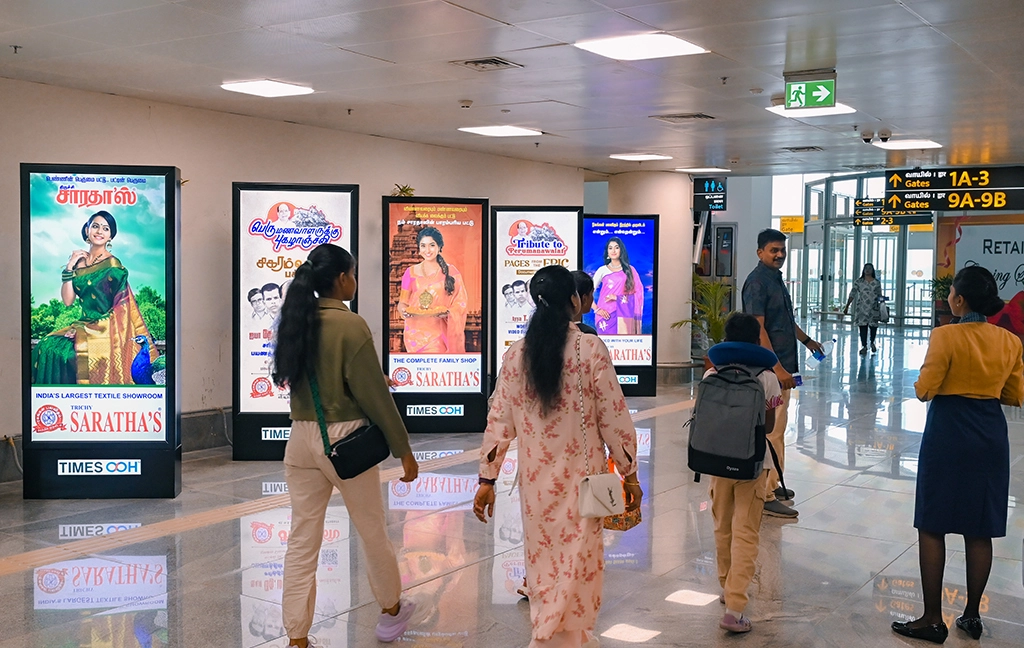
Unlike roadside billboards that compete with distractions, traffic signals, and fleeting visibility, airport advertising delivers extended audience attention in a controlled setting.
Airports provide brands with:
- Captive audiences spending significant dwell time
- High-value travellers who are already self-qualified
- Minimal ad avoidance
- Premium environments associated with trust and credibility
For advertisers targeting decision-makers, affluent consumers, and frequent business travellers, airports create a concentrated media opportunity that is difficult to replicate through city OOH alone.
DOOH in Airports Creates Uninterrupted Audience Attention
Digital out-of-home advertising inside airports benefits from something most urban outdoor campaigns struggle to achieve — uninterrupted engagement.
Travellers often spend long periods waiting at security checkpoints, boarding gates, lounges, baggage claim areas, and transit corridors. This creates repeated exposure opportunities within a single journey.
As a result, airport DOOH campaigns can compress weeks of brand-building exposure into a much shorter and more impactful timeframe.
Industry experts say the effectiveness of airport media increases significantly when campaigns are planned strategically rather than treated as generic outdoor inventory.
Smart Airport Media Planning Matters
Successful airport campaigns are rarely built around scale alone. Instead, performance often depends on:
- Selecting the right terminal
- Understanding traveller journeys
- Matching creative messaging to audience mindset
- Using premium storytelling and authority-driven branding
For example, messaging designed for arriving passengers may differ completely from campaigns targeting business travellers waiting at departure lounges.
When airport media is approached strategically, it becomes less about cost and more about audience quality and brand positioning.
Why More Brands Are Re-Evaluating Airport DOOH
As advertisers increasingly focus on attention metrics, premium audiences, and contextual relevance, airport advertising is emerging as a stronger component within modern omnichannel media strategies.
Rather than asking whether airport media is expensive, brands are beginning to ask a different question:
Can they afford to miss one of the most influential audiences in the advertising landscape?
For premium brands, financial services, technology companies, airlines, hospitality groups, and luxury products, airport DOOH may no longer be an optional branding channel — it may be a competitive advantage.